
Posted on

Air Duct Cleaning in Phoenix: Worth It or a Scam? (Real Prices)


McCUTCHEON & SONS
PHOENIX HVAC & PLUMBING
SINCE 1999 · FAMILY-OWNED · LICENSED #339149

Air Duct Cleaning in Phoenix
Worth It or a Scam? (Real Prices)

mccutcheonandsons.com
(602) 837-3630

A $49 whole-house air duct cleaning does not exist. It is a door opener, and the real number gets added on before the tech leaves your driveway.

Search “air duct cleaning Phoenix” and the first three results are coupons. The whole industry has leaned on one trick for years: get in the door with a price that cannot possibly cover the work, then “find” something that does. By the time the vacuum truck pulls away, the $49 special is a $600 invoice.

None of that means duct cleaning is fake. It means the marketing around it is. Done right, it is a real service that helps a specific kind of house. Done wrong, it is the easiest upsell in the HVAC business. The whole trick is knowing which one you are being offered.

The $49 special is bait

A crew cannot clean a house worth of ductwork for $49. They cannot pay the truck, the fuel, the two techs, and the insurance for that. So the $49 is not the price of the service. It is the price of the appointment.

Once the tech is inside, the pitch starts. Your ducts are full of dust, your coil has mold, your air is making the kids sick. Some of it might even be true. The problem is that you cannot verify any of it while a stranger in a uniform points a flashlight at a dark vent.

The bait-and-switch works because the numbers sound scary and the fix sounds urgent. A real company does not need either of those. It quotes a price for a defined job and stands behind it.

What real Phoenix air duct cleaning costs

A proper whole-house cleaning in the Valley runs $300 to $500 for a typical single-family home. Bigger homes with more runs, or a system that has never been cleaned, push toward the top of that range. Add-on work like sanitizing, sealing, or dryer-vent cleaning runs extra, and should be quoted separately so you can see each line.

The number moves with square footage, the number of vents and returns, and how accessible the ducts are. Attic access on a summer afternoon costs more than a slab house with everything in the garage. Those are honest variables. A flat “$49 any home” is not.

If the quote lands under $250 for a whole house, ask what “whole house” means. Usually it means the visible vents and a long sales pitch for the rest.

When duct cleaning is actually worth it

Most homes do not need their ducts cleaned every year. You need it when something specific changed:

  • Visible dust or debris blowing out of the registers when the system kicks on.
  • Pets. Hair and dander load a duct system fast, especially with several animals.
  • Recent renovation. Drywall dust and construction debris settle in the ducts and keep circulating.
  • Allergies or asthma that flare whenever the AC runs.
  • A smell you can trace to the vents, not the drain or the trash.

Those are real reasons. “It has been a while” is not, on its own, a reason. Dust settles in ducts whether they are clean or not, and a thin layer of settled dust stays put until you disturb it.

When it is a waste of money

If the house is tight, the filters get changed, there are no pets, and nobody in the home has respiratory trouble, a duct cleaning will not change your life or your energy bill. The air moving through a duct is already filtered at the return. The dust in the duct is not the dust in your lungs, most of the time.

The honest pitch is narrow. A real contractor tells you when you do not need the service. That is the single most reliable test of the whole industry.

Air duct cleaning in Phoenix: real prices and the red flags that separate a service from a scam

The red flags that separate a real Phoenix duct cleaning from a $49 bait-and-switch.

The camera test

Before you sign anything, ask for one thing: a camera. A legitimate duct cleaner runs a camera into the trunk line, shows you the before and the after, and lets you watch the debris actually come out. A scammer works blind, tells you it is “really bad in there,” and hands you a bill.

No before-and-after camera, no real service. That is not a hard rule invented for a blog post. It is the difference between a company that can prove its work and one that needs you to take it on faith.

While you are at it, verify the license. Every legitimate contractor in Arizona carries a Registrar of Contractors license, and it is public record. If they will not give you the number, that is your answer.

The honest take

Air duct cleaning in Phoenix is worth it for the right house and a waste for the wrong one. The problem is that the whole industry is built to sell it to everyone. The $49 coupon, the scare photo, the “mold” found in a vent nobody looked in, all of it is engineered to turn a $0 need into a $600 ticket.

A family-owned shop that has been working the Valley since 1999 does not need the tricks. We would rather tell you the ducts are fine and save you the money, because you will remember that the next time the AC goes down in July. That is the whole business model: do right by the neighbor, and they call back.

Not sure if your ducts actually need it? Get a straight answer first.

McCutcheon & Sons is a family-owned and operated HVAC and plumbing company serving Phoenix and the east valley: Gilbert, Chandler, Mesa, Queen Creek, San Tan, Tempe, Maricopa, Scottsdale, and Fountain Hills. Since 1999, one name on the truck, the quote, and the door. Licensed #339149. No commissions, no hidden costs, guaranteed work.

Call (602) 837-3630

McCutcheon & Sons Air Conditioning and Plumbing · (602) 837-3630 · mccutcheonandsons.com · AZ ROC License #339149
Posted on

AC Refrigerant Recharge Cost: Why It Went Up (R-410A to R-454B)


McCUTCHEON & SONS
PHOENIX HVAC & PLUMBING
SINCE 1999 · FAMILY-OWNED · LICENSED #339149

AC Refrigerant Recharge Cost: Why It Went Up
R-410A to R-454B

mccutcheonandsons.com
(602) 837-3630

The gas inside your AC has become the most expensive thing about the machine, and almost no one sees it coming. A recharge that cost a couple hundred dollars a few years ago can now hit triple digits before the tech even finds the leak.

The reason isn’t a greedy contractor. It’s a federal law called the AIM Act, and it’s quietly rewriting the price of every pound of refrigerant in Phoenix. If your AC is a few years old and short on charge, this is what you actually need to know before you pay the bill.

The gas that used to fill nearly every home AC, R-410A, is being phased down. The replacement, R-454B, costs more, is mildly flammable, and can’t just be poured into your old system. That’s the whole story in three sentences, but the details are where the money hides.

R-410A vs R-454B refrigerant comparison: GWP, price, and what changed

Why the price jumped on a gas you never see

In 2020 Congress passed the AIM Act, which phases down the production of the high-global-warming refrigerants that have cooled American homes for decades. R-410A is the big one. As of January 1, 2025, new HVAC equipment can no longer be built to run on it. The supply that’s left is reserved for servicing the millions of existing units, and reserved supply means rising prices.

The result is exactly what you’d expect. R-410A has roughly doubled in price in two years, from around $22 a pound to $45 and climbing. Every pound the tech has to add to your system, you pay for at the new number.

R-410A vs R-454B, the short version

The new refrigerant, R-454B, has a global warming potential of 466, a fraction of R-410A’s 2,088. That’s the whole point of the law. But it comes with catches. R-454B is classified A2L, meaning mildly flammable, so it requires new equipment, different tools, leak sensors, and updated code compliance. It is not a drop-in replacement for R-410A. You can’t top off an old system with it, and you shouldn’t.

The transition has also squeezed the new stuff. Honeywell added a 42% surcharge on R-454B, plus a $4-per-pound base increase, and prices spiked from around $10 a pound to as much as $80. New A2L equipment lands about 8 to 12% higher at the customer, which is one reason replacement quotes have jumped.

What a recharge actually costs in 2026

A recharge bill has three parts: the refrigerant itself, the labor, and the leak search. The refrigerant is priced by the pound, and most home systems hold several pounds. The labor is the trip, the gauges, and the time. The leak search is where the honest shops separate from the rest, because a recharge without finding the leak is money down a hole.

That’s the number to ask about up front. A shop that quotes a flat “recharge” without mentioning a leak search, or without explaining how many pounds your system actually needs, is not doing you a favor. Get the breakdown before you sign.

A recharge is a band-aid, not a fix

Refrigerant doesn’t get used up. If your system is low, it leaked. Adding gas without finding and repairing the leak means you’ll be back in the same spot next summer, paying a higher price per pound. The fix is the repair, not the refill.

On an older R-410A system, that’s a real decision. The gas keeps getting more expensive, and the unit keeps getting older. Sometimes the right call is to repair the leak and keep it running. Sometimes it’s to stop feeding an aging machine and put the money toward a replacement. A straight answer on which one you’re looking at is worth more than the recharge itself.

How to not get soaked on the price

  1. Ask for the pound count. Your system holds a specific charge, and you should know how much you’re paying for.
  2. Ask about the leak. No leak search, no deal. A recharge alone is not a repair.
  3. Ask for the breakdown. Refrigerant, labor, and leak search as separate line items.
  4. Get a second opinion on a big number. A replacement quote in the $15,000 to $20,000 range deserves the same scrutiny you’d give a used car.

The EPA’s AIM Act page spells out the phasedown schedule if you want the full regulatory picture.

When your AC is short on charge, the honest path is the same as any AC not cooling call: find the real problem, tell you the truth about it, and charge what it actually costs to fix. Whether that’s a leak repair or a replacement, you should know before the gauges go on.

That’s how we’ve run it since 1999. We’ll show you the pounds, the leak, and the price, then let you decide. No pressure, no hidden line items, just the heating and cooling work your house actually needs.

If that sounds like the company you’ve been searching for, we’re one call away.

McCutcheon & Sons is a family-owned and operated HVAC and plumbing company serving Phoenix and the east valley: Gilbert, Chandler, Mesa, Queen Creek, San Tan, Tempe, Maricopa, Scottsdale, and Fountain Hills. Since 1999, one name on the truck, the quote, and the door. Licensed #339149. No commissions, no hidden costs, guaranteed work.

Call (602) 837-3630

McCutcheon & Sons Air Conditioning and Plumbing · (602) 837-3630 · mccutcheonandsons.com · AZ ROC License #339149
Posted on

Swamp Cooler vs AC in Phoenix: Which Cools Cheaper?


McCUTCHEON & SONS
PHOENIX HVAC & PLUMBING
SINCE 1999 · FAMILY-OWNED · LICENSED #339149
Swamp Cooler vs AC in Phoenix
Which Cools Cheaper?
mccutcheonandsons.com
(602) 837-3630

A swamp cooler can run a whole Phoenix summer on about a quarter of the electricity an AC pulls. It can also turn a July afternoon into a muggy, sticky mess the moment the monsoon rolls in. Which one is cheaper depends on which month you’re asking about.

Both machines cool the same square feet. They just do it in completely different ways, and the difference shows up on your bill, in your comfort, and in how much of your house you can actually use when it’s 110 outside.

Swamp cooler vs AC: electricity, install cost, and the humidity limit

They cool in two completely different ways

A swamp cooler, or evaporative cooler, pulls hot dry outside air through wet pads. The water evaporates, the evaporation absorbs heat, and the air that comes out the vent is cooler and wetter. It’s the same physics as stepping out of a pool into a breeze.

A refrigerated AC is a different machine entirely. It runs refrigerant through a coil to pull heat out of the air and dump it outside, and it strips moisture out of the indoor air as it works. One system relies on dry air. The other doesn’t care about humidity at all.

The electricity math is why people still love them

This is the number that keeps swamp coolers alive in Phoenix. According to the Department of Energy, an evaporative cooler costs about half as much to install as central AC and uses about a quarter of the energy, sometimes up to 75% less. One Phoenix homeowner told KJZZ his bills ran about $90 a month on a swamp cooler versus $320 a month after switching to AC.

That gap is real. A swamp cooler is essentially a fan, a pump, and some water, running maybe 3 to 15 gallons an hour. The water is a cost, but it doesn’t come close to eating the electricity savings. On paper, and on a dry April afternoon, the swamp cooler wins in a landslide.

The monsoon is the catch

Evaporative cooling only works when the air is dry enough to take the water. Here’s the drop you actually get, by humidity:

  1. Under 30% humidity: 18 to 25 degrees of cooling. Excellent.
  2. 30% to 40%: 12 to 18 degrees. Very good.
  3. 40% to 50%: 6 to 12 degrees. Marginal.
  4. Over 50%: under 6 degrees. You’re just adding mugginess.

Phoenix’s monsoon, roughly mid-June through September, drives the humidity straight into that bottom row, right when you need the cooling most. The same swamp cooler that felt great in May blows warm, sticky air in August. A refrigerated AC keeps working through all of it and dehumidifies the house while it’s at it.

What a swamp cooler can’t do

The savings come with trade-offs. A swamp cooler needs windows or vents cracked open to move air, so it doesn’t work with a sealed, well-insulated house. It doesn’t dehumidify, it adds moisture. It doesn’t filter the air the way an AC does. It needs regular maintenance: pads, mineral buildup, algae, and a winterizing routine every fall.

It also cools less precisely. On a 115-degree day, a swamp cooler that’s doing its best drops the air to somewhere in the 90s. Comfortable in moving air, but not the same as a set-and-forget 78.

The hybrid setup most Phoenix homes actually run

Here’s the pattern that’s been working in the Valley for decades. Run the swamp cooler through the dry shoulder months, April through June and September through October, and flip to refrigerated AC when the dew point climbs. You capture the cheap months and survive the sticky ones.

That’s why the honest answer to “which is cheaper” is “both, in the right season.” If you’re choosing one system for a year-round home, AC is the safer call. If you’re cooling a garage, a workshop, or a patio, or you already have AC and want to shave the dry-season bills, the swamp cooler earns its keep. The right choice starts with a straight read on your house, which is exactly what a second opinion is for.

The Department of Energy has a solid primer on evaporative coolers if you want the full spec sheet.

If that sounds like the company you’ve been searching for, we’re one call away.

McCutcheon & Sons is a family-owned and operated HVAC and plumbing company serving Phoenix and the east valley: Gilbert, Chandler, Mesa, Queen Creek, San Tan, Tempe, Maricopa, Scottsdale, and Fountain Hills. Since 1999, one name on the truck, the quote, and the door. Licensed #339149. No commissions, no hidden costs, guaranteed work.

Call (602) 837-3630

McCutcheon & Sons Air Conditioning and Plumbing · (602) 837-3630 · mccutcheonandsons.com · AZ ROC License #339149

Posted on

Heat Pumps in Phoenix: Do They Actually Work in Arizona Heat?


McCUTCHEON & SONS
PHOENIX HVAC & PLUMBING
SINCE 1999 · FAMILY-OWNED · LICENSED #339149
Heat Pumps in Phoenix: Do They Actually Work
in Arizona Heat?
mccutcheonandsons.com
(602) 837-3630

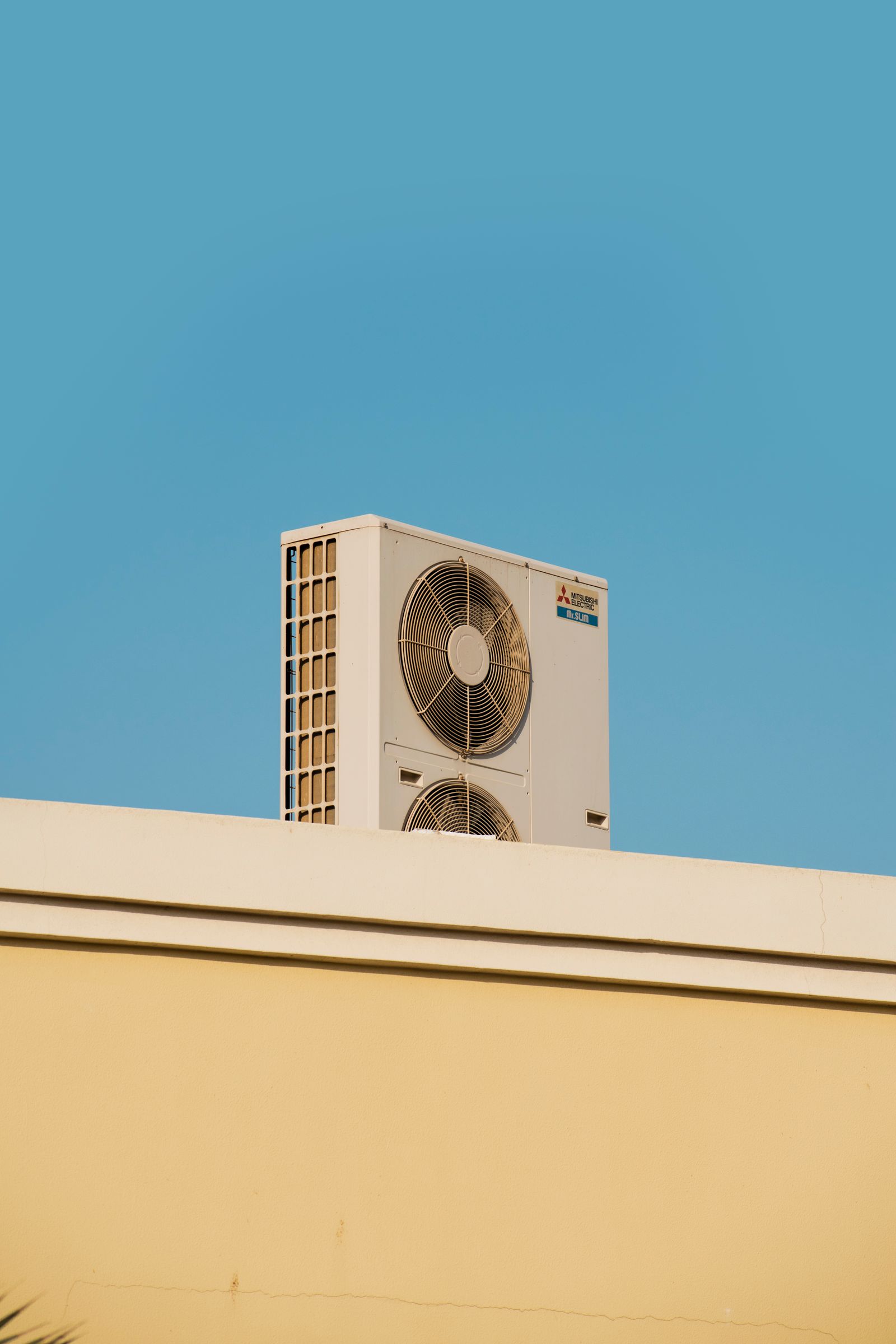
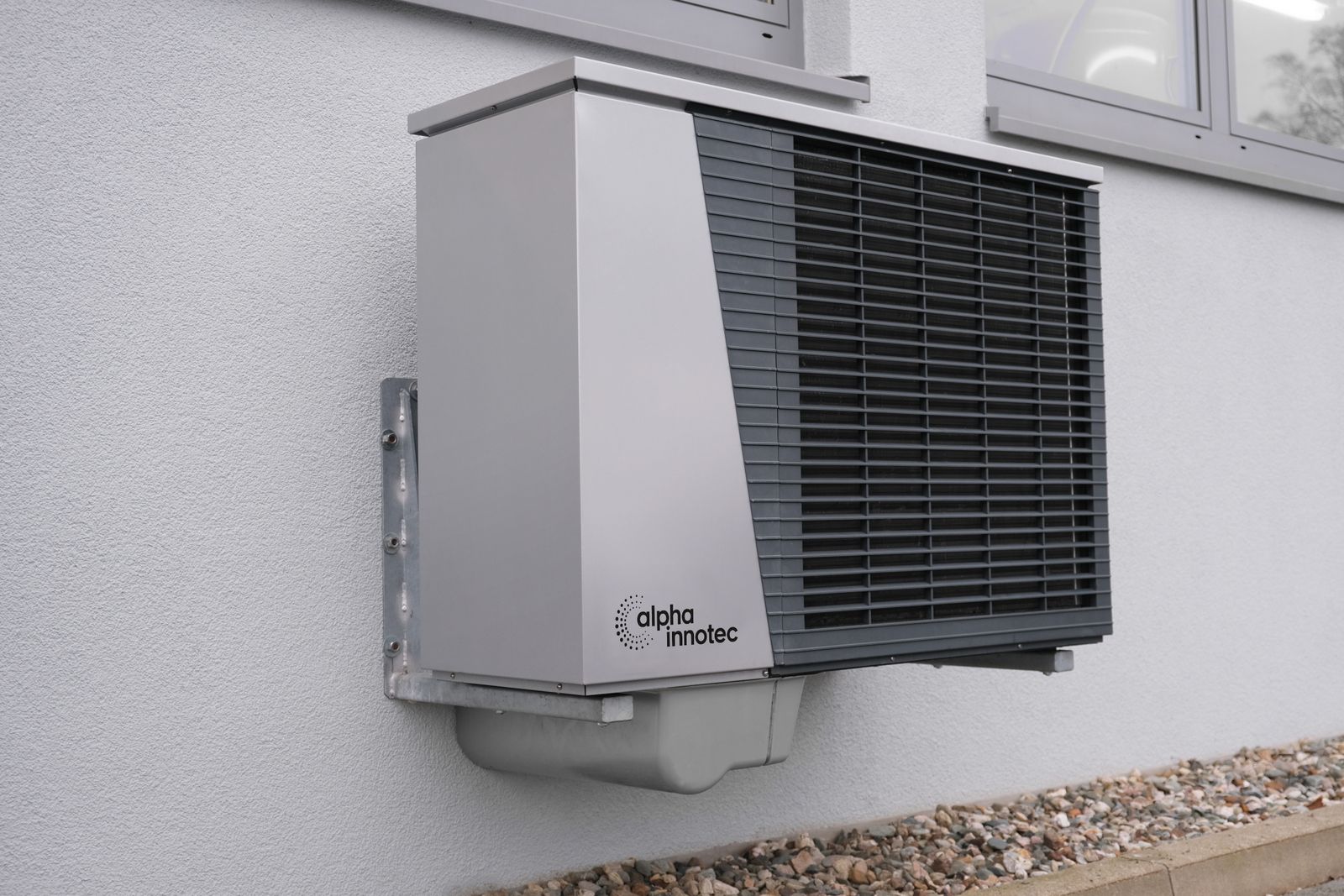
People hear the word “heat pump” and think of a machine built for cold places like Chicago or Boston. In Phoenix, the question runs the other way: will it actually keep a house cool when it’s 115 outside, and will it ever need to heat anything at all?

The answer surprises a lot of homeowners. In cooling mode, a heat pump is the same machine as a regular air conditioner. Same compressor, same refrigerant cycle, same SEER2 rating on the label. It cools a Phoenix summer exactly as well as a comparable AC, because it is one.

The only difference is that it can run the cycle in reverse. On the handful of nights Phoenix actually gets cold, it heats the house too. Whether that matters depends on your house, your rate plan, and how the rebates shake out this year.

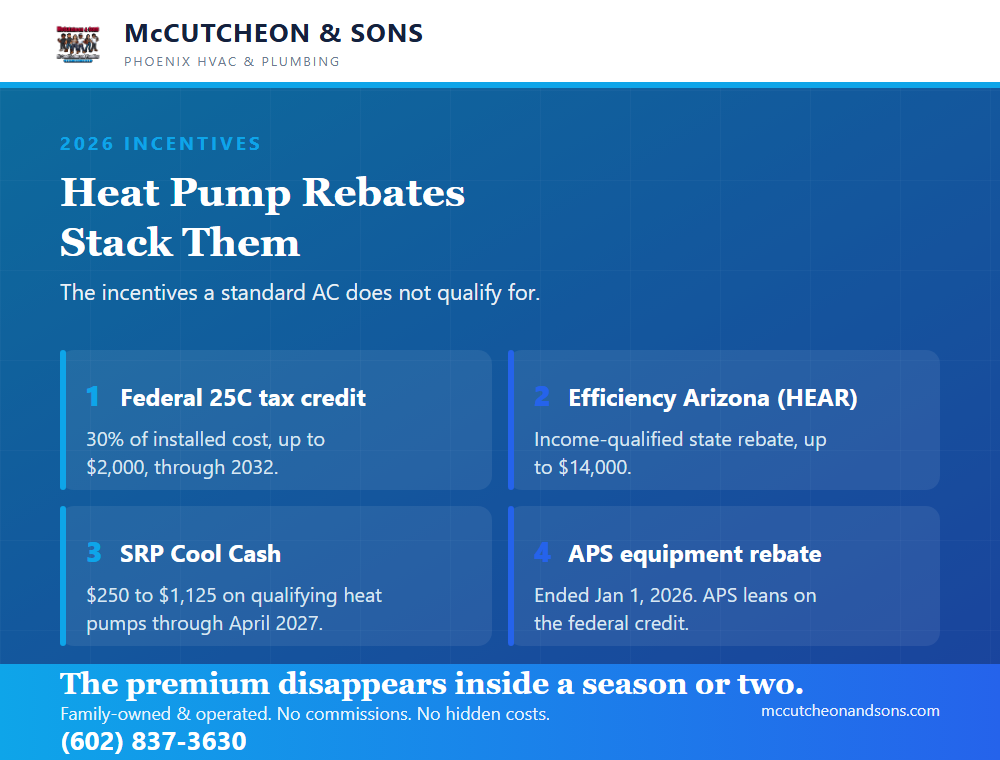
Heat pump rebate stack: federal 25C tax credit, Efficiency Arizona, and SRP Cool Cash

A heat pump in cooling mode is just an air conditioner

Strip away the name and a heat pump is an AC unit with a reversing valve. For the six months of the year that Phoenix runs cooling, that valve stays in one position and the unit behaves exactly like the AC you already know. Modern units are rated to hold capacity at 110 to 115 degrees and beyond, the same as a high-efficiency central system.

That means the old fear, that a heat pump can’t handle an Arizona summer, is mostly outdated. What actually decides whether the house stays comfortable is the same thing that decides it for any AC: correct sizing, a clean condenser coil, and a correct refrigerant charge.

Where Phoenix is easier than most of the country

Heat pumps earn their reputation problems in cold climates, where they have to pull heat out of air that’s below freezing. Phoenix doesn’t have that problem. Our winter lows barely touch the 40s, which is a walk in the park for a heat pump.

The result is that a Phoenix heat pump rarely leans on its backup electric heat strips. It heats efficiently all winter, in the mildest heating season in the country. You get the full benefit of the technology without the northern caveats.

The efficiency is real, but read the fine print

A heat pump can move three to four units of heat for every unit of electricity it uses, which is where the “up to 400% efficient” numbers come from. Compared to old electric resistance heat, the savings are big. Some Phoenix homeowners report their combined gas and electric bill dropping from around $200 to $70 a month after a switch to a variable-speed heat pump.

The honest caveat: compared to a high-efficiency gas furnace, the heating savings in Phoenix are modest, because our heating season is short and mild. The real payoff comes from three places: efficient cooling, one system doing both jobs, and the incentives that are only on the table for a heat pump.

What a Phoenix heat pump costs in 2026

Installed prices run a wide range. A like-for-like swap lands around $8,000 to $12,000. A variable-speed system, or a full conversion, runs $16,000 to $22,000. Ductless versions start lower, in the mini-split range of $3,000 and up.

That spread is normal. The price moves on size, SEER2 rating, and whether the job is a straight swap or a full redesign of the ductwork and electrical. A straight answer with real numbers is the test of any quote, same as an AC replacement.

The rebates are the reason to do the math now

A heat pump is the one cooling choice that unlocks a stack of incentives a standard AC doesn’t qualify for:

  1. The federal 25C tax credit covers 30% of the installed cost, up to $2,000, for qualifying heat pumps, through 2032. A standard AC replacement gets nothing.
  2. Efficiency Arizona (HEAR) is the income-qualified state program, with rebates that can reach $14,000 depending on household income and project scope.
  3. SRP Cool Cash pays $250 to $1,125 on qualifying heat pumps through April 2027.
  4. APS equipment rebates ended January 1, 2026, so APS customers lean on the federal credit and any current offers.

Stack them and the premium a heat pump carries can disappear inside a season or two. The Department of Energy’s heat pump guide is the place to verify current numbers before you sign.

How to make sure it actually works at 115 degrees

A heat pump only performs as well as the install. Ask for a Manual J load calculation, not a guess based on your old unit. Look at the EER2 rating, which matters more than SEER2 in extreme heat. And pick a shop that services what it sells, because a heat pump in August is only as good as the person who shows up when it trips.

That’s where a family-owned shop has an edge. We’ve been sizing and installing cooling in the east valley since 1999, and we’ll tell you straight whether a heat pump or a conventional AC is the better buy for your house and your rate plan.

If that sounds like the company you’ve been searching for, we’re one call away.

McCutcheon & Sons is a family-owned and operated HVAC and plumbing company serving Phoenix and the east valley: Gilbert, Chandler, Mesa, Queen Creek, San Tan, Tempe, Maricopa, Scottsdale, and Fountain Hills. Since 1999, one name on the truck, the quote, and the door. Licensed #339149. No commissions, no hidden costs, guaranteed work.

Call (602) 837-3630

McCutcheon & Sons Air Conditioning and Plumbing · (602) 837-3630 · mccutcheonandsons.com · AZ ROC License #339149
Posted on

Ductless Mini-Split vs Central AC in Phoenix: Pros, Cons, and Cost


McCUTCHEON & SONS
PHOENIX HVAC & PLUMBING
SINCE 1999 · FAMILY-OWNED · LICENSED #339149
Ductless Mini-Split vs Central AC
in Phoenix: Pros, Cons, and Cost
mccutcheonandsons.com
(602) 837-3630

Somewhere between the room that never cools and the bedrooms that stay perfect is the argument every Phoenix homeowner eventually has about ductless units. Mini-splits have a reputation as the cheap fix for a hot room. They are also, in the right house, the smartest money you can spend on cooling.

But they are not the answer for every home, and picking wrong means either a system that cannot keep up or a whole-house replacement you did not need. Here is the honest comparison, Phoenix-specific, so you can decide with your house in mind instead of a sales pitch.

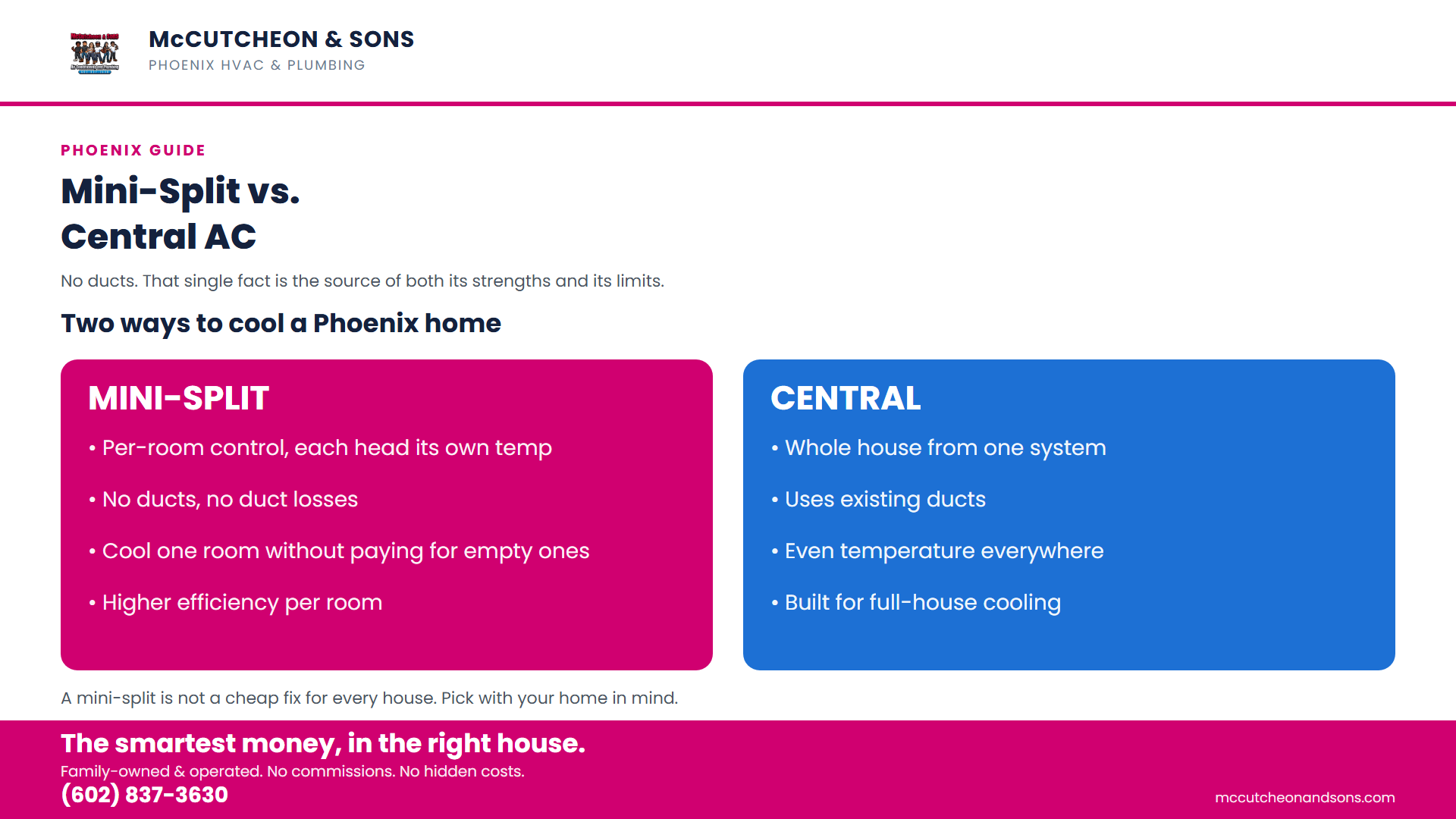
Ductless mini-split vs central AC in Phoenix: two ways to cool a home compared

What a ductless system actually is

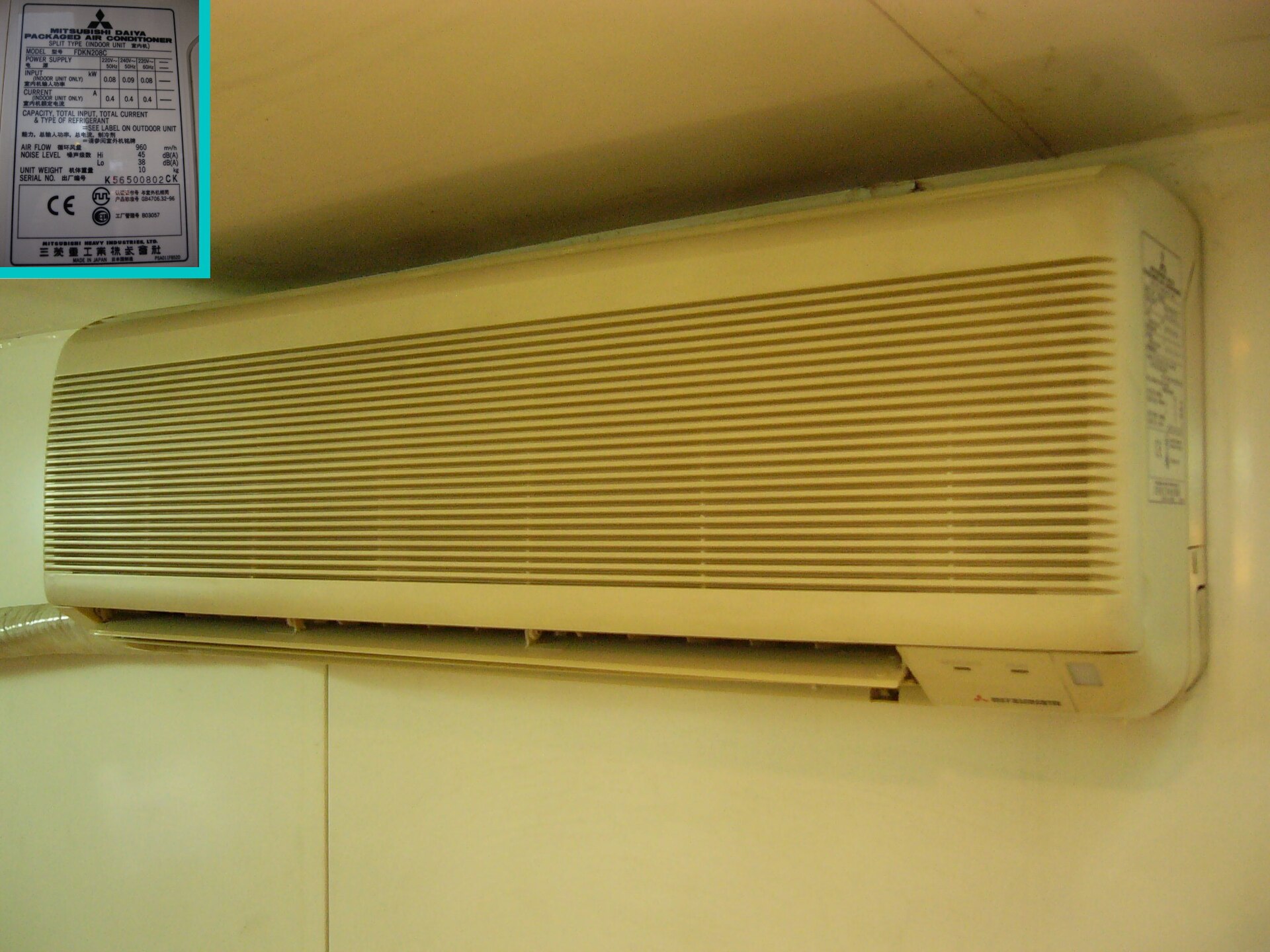
A ductless mini-split is an installation that pairs an outdoor condenser with one or more slim indoor units mounted on the wall or ceiling, connected only by a small refrigerant line. There are no ducts. That single fact is the source of both its strengths and its limits.

Each indoor head cools the room it serves, and each head can be set to its own temperature. That means you can run the bedroom cold at night without paying to cool an empty living room, which is a capability a central system simply does not have.

Where a mini-split wins in Phoenix

Mini-splits shine in the specific situations that central air handles badly.

The first is the hot room. Half the service calls we get are a single bedroom or a west-facing addition that never cools while the rest of the house is fine. Adding a ductless unit to that room solves the problem for a fraction of what re-ducting the whole house would cost. The second is the add-on space: a garage workshop, a casita, a converted patio. Running new ductwork to those spaces is expensive and ugly. A ductless head mounts in an afternoon. The third is the older home with no existing ductwork at all, where a full central system is a gut job and a multi-zone ductless setup is the only reasonable way to get cooling.

There is an efficiency argument too. Because there are no ducts, you lose none of the cooled air to leaky, dusty attic ductwork, and the variable-speed compressors on modern mini-splits are genuinely efficient. The ENERGY STAR page on ductless heating and cooling covers the ratings if you want the numbers.

Where central air still beats it

For a whole 2,500-square-foot house that already has good ductwork, central air is usually still the right call. A single central system cools every room evenly, which ductless does only if you install a head in every room, and that gets expensive fast.

Central also wins on filtration and aesthetics. A central system can move air through a serious filter that pulls dust and allergens out of the whole house, which matters in dusty Phoenix. A mini-split only filters the room it is in, through a thin, washable screen. And on resale, a house with central AC simply reads as a finished house in a way a ductless wall unit does not.

What a ductless install costs in the Valley

A single-zone ductless system installed in a Phoenix home runs roughly $3,500 to $6,000, depending on the brand and the difficulty of the run. That is the honest number for a quality unit, not a big-box special with no installer behind it.

A multi-zone system with two or three indoor heads runs $8,000 to $15,000. At that point you are in central-air replacement territory, and the decision flips from cost to what your house actually needs. The cheapest way to use a mini-split is not to cool a whole house with it. It is to fix the one room central air cannot reach.

What central costs by comparison

A full central heating and cooling replacement in Phoenix runs $7,000 to $14,000 for most homes, installed. So a single-room mini-split is a bargain next to a whole-house central system, and a whole-house multi-zone mini-split is a wash.

The math that actually matters is simpler: if the problem is one room, ductless wins on price every time. If the problem is the whole house, central wins on comfort and resale, and the prices are close enough that the layout should decide.

The right tool for the right house

Ask three questions before you pick. Does the space already have ductwork? Is the problem one room or the whole house? And how much do you care about whole-house filtration and resale value?

A hot bedroom, a garage, or a casita with no ducts is a mini-split job. A whole house with good ducts and a tired central unit is a central replacement job. Most homes fall into a mix, which is why the right answer is often both: keep the central system, and add a ductless unit to the one room it has always failed. A good maintenance plan keeps both running, because a mini-split needs its filter and coil cleaned as regularly as any other unit.

The honest take

A mini-split is not better than central air and it is not worse. It is a different tool for a different problem, and a family-owned shop will tell you which one your house actually needs. In Phoenix, where a single hot room can make a whole house miserable for five months a year, that tool earns its keep.

Tell us which room never cools, and we will tell you whether ductless or central is the smarter spend before you sign for either one. Ask for an instant quote and we will put the number in writing. That is the difference between buying a system and buying the right system.

If that sounds like the company you’ve been searching for, we’re one call away.

McCutcheon & Sons is a family-owned and operated HVAC and plumbing company serving Phoenix and the east valley: Gilbert, Chandler, Mesa, Queen Creek, San Tan, Tempe, Maricopa, Scottsdale, and Fountain Hills. Since 1999, one name on the truck, the quote, and the door. Licensed #339149. No commissions, no hidden costs, guaranteed work.

Call (602) 837-3630

McCutcheon & Sons Air Conditioning and Plumbing · (602) 837-3630 · mccutcheonandsons.com · AZ ROC License #339149
Posted on

AC Tune-Up & Maintenance in Phoenix: Is It Worth It? (What’s Actually Included)


McCUTCHEON & SONS
PHOENIX HVAC & PLUMBING
SINCE 1999 · FAMILY-OWNED · LICENSED #339149
AC Tune-Up & Maintenance in Phoenix
Is It Worth It? (What’s Actually Included)
mccutcheonandsons.com
(602) 837-3630

Every spring, the same question shows up in Phoenix group chats and on every homeowner forum: is the $100 tune-up a real service, or a way to sell me a new unit I do not need? The honest answer is both, and it depends entirely on who is holding the checklist.

A tune-up from the right company is the cheapest insurance a Phoenix homeowner can buy on the machine that keeps their house livable for six months a year. A tune-up from the wrong one is a sales appointment wearing a maintenance uniform. Here is how to tell the difference before you book.

What an AC tune-up actually includes: coil, drain line, refrigerant, capacitor, and filter checklist

What a Phoenix tune-up is, and what it is not

A maintenance visit is an inspection plus a cleaning, not a repair. It is a chance to catch a failing capacitor or a clogged condensate drain in April, when the fix is a $150 part, instead of in July, when the same failure is a 2 a.m. emergency call on a 112-degree night.

What it is not is a performance upgrade. A tune-up will not make a 20-year-old unit run like a new one, and any tech who promises that is setting you up to be sold a replacement before you leave the driveway.

What is actually on the checklist

A real tune-up touches the whole system, not just the outside unit. The honest checklist looks like this:

Clean or replace the air filter, which also means better indoor air quality. Clean the condenser coil so the unit can actually reject heat. Clear the condensate drain line so it does not back up into your ceiling. Check the capacitor and contactor, which are the two parts most likely to fail mid-summer. Test refrigerant pressures and the temperature split between supply and return air. Check electrical connections and amp draw so a loose wire does not become a fire. And confirm the thermostat is reading and cycling correctly.

If the tune-up you are quoted is just a filter swap and a coil rinse for $149, you are paying a premium for ten minutes of work. If it is the full list above, it is money well spent.

What it costs in the Valley

A standalone heating and cooling tune-up in Phoenix runs about $79 to $150. Most companies, including ours, fold the same work into a maintenance plan that costs roughly $10 to $15 a month and usually includes the visit, priority scheduling, and a discount on repairs when something does break.

That is the real value of the plan: not the discount, but the scheduling priority. In August, a plan member gets a tech in a day while a stranger waits a week in a hot house.

The honest math on what you get back

A tune-up pays for itself the first time it catches a part before it fails. A capacitor is a $10 part and a $150 to $250 repair with labor, and it fails in Phoenix heat more than any other component. Catching it in the spring costs you a tune-up. Missing it costs you a repair call, a hot weekend, and possibly a compressor if the failing capacitor takes the motor with it.

There is a lifespan argument too. A system that runs 3,000 hours a year and gets cleaned and checked twice in that time simply lasts longer than one that runs until it fails. The ENERGY STAR guidance on central air conditioning recommends exactly this kind of seasonal service, and for good reason.

When a tune-up turns into a repair call

This is where the honest companies and the commission shops split. A good tech finds a weak part and tells you it can wait, then gives you a price to fix it on your terms. A commission tech finds the same weak part and tells you the whole system is on borrowed time and you should sign for a replacement today.

The tell is the speed of the upsell. If every tune-up ends with a clipboard and a financing pitch, that is not maintenance. That is lead generation. A real tech will show you the failed part, show you the reading, and let you decide.

How often you really need one in Phoenix

In most of the country, once a year is plenty. Phoenix is not most of the country. With a unit running from April through October, the right cadence here is twice a year: once in the spring before the heat arrives, and once in the fall after the monsoon dust has coated everything.

The fall visit is the one people skip, and it is the one that catches the damage monsoon dust and debris do to the coil. Skip the spring visit and you risk a breakdown. Skip the fall visit and you pay for it in efficiency all through the mild season.

The honest take

A tune-up is worth it when it is a real inspection by a company that is there to maintain, not to sell. It is a waste when it is a ten-minute upsell visit in a uniform.

Book it from a family-owned shop that does the full checklist, get an instant quote before you commit, and you will spend a little every year to avoid a lot all at once. That is the whole trade, and it is the cheapest insurance you will ever buy on a Phoenix summer.

If that sounds like the company you’ve been searching for, we’re one call away.

McCutcheon & Sons is a family-owned and operated HVAC and plumbing company serving Phoenix and the east valley: Gilbert, Chandler, Mesa, Queen Creek, San Tan, Tempe, Maricopa, Scottsdale, and Fountain Hills. Since 1999, one name on the truck, the quote, and the door. Licensed #339149. No commissions, no hidden costs, guaranteed work.

Call (602) 837-3630

McCutcheon & Sons Air Conditioning and Plumbing · (602) 837-3630 · mccutcheonandsons.com · AZ ROC License #339149
Posted on

Why Is Plumbing So Expensive in Phoenix? A Real Breakdown


McCUTCHEON & SONS
PHOENIX HVAC & PLUMBING
SINCE 1999 · FAMILY-OWNED · LICENSED #339149
Why Is Plumbing So Expensive
in Phoenix? A Real Breakdown
mccutcheonandsons.com
(602) 837-3630

You call a plumber for a faucet that drips, and the invoice lands at $400. It is the most common sticker shock in the trades, and in Phoenix it stings harder than almost anywhere else in the country.

Plumbing is not expensive because plumbers are greedy. It is expensive because of what is actually happening between the phone call and the finished repair. Once you see the breakdown, a $400 bill stops looking like a scam and starts looking like what the job genuinely costs.

Why plumbing is expensive in Phoenix: the real breakdown of the service call fee, licensed labor, drive time, and parts

The service call fee is doing more work than you think

That first number on the invoice, usually $79 to $129 in the Valley, is not profit. It covers a licensed technician, a stocked truck, fuel, insurance, and the dispatch time to get to your door before the trip even starts. In a metro as spread out as Phoenix, where a plumber in Gilbert might take a call in the east valley and drive forty minutes each way, that fee is the cost of showing up at all.

Every trade has this fee. Plumbers just get more flack for it because plumbing emergencies feel more like a ransom than a service.

What you are actually paying for

A real plumbing call buys a licensed pro who is insured, drug-tested, and accountable to the state registrar of contractors. That license is not a piece of paper. It is proof the person on your property can do the work without flooding your slab or poisoning your water line.

You are also paying for the guarantee. A handyman charges $40 an hour and leaves. A licensed plumber charges more and stands behind the repair, because a callback is the most expensive thing in the trade. The difference shows up the first time a repair holds for ten years instead of ten weeks.

Phoenix water and slab foundations make it worse

Two local facts push Phoenix plumbing bills above the national average, and neither is the plumber’s fault.

The first is hard water. The mineral-heavy water in the Valley eats faucets, fills water heaters with scale, and shortens the life of every valve and cartridge it touches. Your plumber is not just fixing today’s leak. They are often undoing years of mineral damage, which is a slower, more involved job than the same repair in a soft-water city.

The second is the slab. Most Phoenix homes sit on concrete slabs with water lines buried inside them. When a line leaks under the slab, the fix is not a crawlspace patch. It is leak detection, saw-cutting, and repiping, and that is genuinely expensive work. Compare that to a house with a basement where the pipes are exposed, and you see why the same leak costs three times as much here.

Why the same job has a $150 and a $900 version

Flat-rate pricing is the quiet reason plumbing prices vary so wildly. Under flat-rate, a company charges by the book: a clog is always $250, a water heater swap is always $1,400, whether the actual work takes twenty minutes or two hours. It makes quoting fast and predictable, which customers like, but it also means the easy jobs subsidize the hard ones.

Add commission pay on top, and the price moves again. A technician paid to sell will find a water softener or a new water heater in your future whether you need one or not. That is not every company. But it is enough of them that the same clog can be $150 from one shop and $900 from another, and the difference is the incentive structure, not the wrench.

Where the price is actually fair

So what should you expect to pay for honest work in Phoenix in 2026? A service call of $79 to $129, hourly rates of $120 to $200 for a licensed tech, a straightforward faucet or drain repair in the $150 to $350 range, and a water heater replacement in the $1,200 to $2,000 range depending on the unit. Those numbers are not cheap, but they are fair, and they are what a company with no commission pressure will actually charge you. You can see typical rates for common fixes on our FAQs page.

You can check the national picture on the Bureau of Labor Statistics page for plumbers, pipefitters, and steamfitters to see why skilled labor costs what it does.

How to pay less without skipping the fix

The way to lower a plumbing bill is not to find the cheapest tech. It is to bundle. If the plumber is already at your house, the second and third small repairs cost far less on the same trip than they would as three separate service calls. Ask for a line-item breakdown before you approve, and do not let a water heater quote turn into a whole-house repipe you did not ask for.

And if it is not actively leaking, schedule it for a normal-hour visit. Emergency after-hours rates are the single biggest avoidable markup in the trade, and half the jobs billed as emergencies could have waited until morning.

The honest take

Plumbing in Phoenix costs more because a spread-out city, hard water, slab foundations, and real licensing all land on the same invoice. None of that is padding. The padding only shows up when a commission target or a flat-rate book gets between you and the actual fix.

Find a family-owned shop with reviews that back it up, and one that shows you the line items, and the price you pay will finally match the work you got.

If that sounds like the company you’ve been searching for, we’re one call away.

McCutcheon & Sons is a family-owned and operated HVAC and plumbing company serving Phoenix and the east valley: Gilbert, Chandler, Mesa, Queen Creek, San Tan, Tempe, Maricopa, Scottsdale, and Fountain Hills. Since 1999, one name on the truck, the quote, and the door. Licensed #339149. No commissions, no hidden costs, guaranteed work.

Call (602) 837-3630

McCutcheon & Sons Air Conditioning and Plumbing · (602) 837-3630 · mccutcheonandsons.com · AZ ROC License #339149
Posted on

What Does an AC Replacement Actually Cost in Phoenix? (2026 Price Guide)


McCUTCHEON & SONS
PHOENIX HVAC & PLUMBING
SINCE 1999 · FAMILY-OWNED · LICENSED #339149
What Does an AC Replacement
Actually Cost in Phoenix? (2026 Price Guide)
mccutcheonandsons.com
(602) 837-3630

The moment an AC tech says the word replacement, the next number that flashes through your head has a dollar sign in front of it. It is the biggest single decision most Phoenix homeowners make on their house, and the quotes run anywhere from $6,000 to $20,000 depending on who you ask.

In the Valley, a new air conditioning system is not a luxury purchase. It is the machine that keeps a 115-degree house livable from May through October. That is why the price scares people, and why the same job can be quoted at two wildly different numbers a week apart.

This guide walks through what a replacement actually costs in Phoenix in 2026, line by line, so you know which number on your quote is real and which one is a sales target.

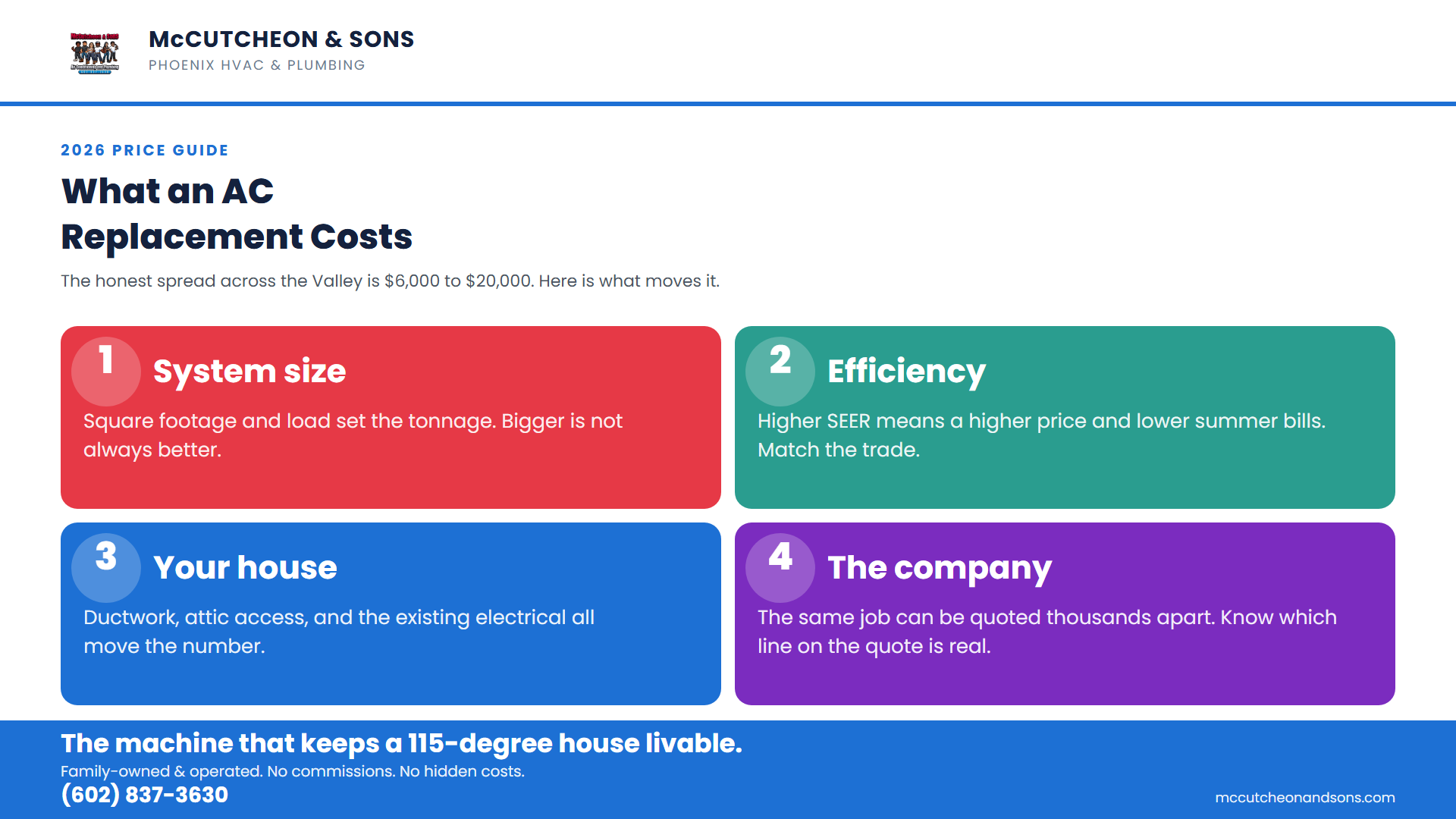
AC replacement cost guide for Phoenix: what moves the price from $6,000 to $20,000

The number most people hear, and what it actually means

Ask a room of Phoenix homeowners what a new AC costs and you will get a range so wide it is useless. The reason is simple: there is no single price for an air conditioner. There is a price for a system of a certain size, at a certain efficiency, installed into a certain house, by a certain company.

The headline number you hear is almost always a system-only price with no context. A 2-ton unit on a 1,400-square-foot condo is not the same job as a 5-ton rooftop package unit on a 2,800-square-foot house in Gilbert. Same word, replacement. Different check.

Why a Phoenix replacement runs higher than the national average

Phoenix is not a national-average market, and that is not a complaint. It is physics and geography.

First, the runtime. A Phoenix AC runs more hours in one summer than a Seattle unit runs in three years. That constant load means units here get sized and built for heat, not for mild comfort, and the equipment reflects it. Second, a huge share of Valley homes run rooftop package units rather than a split system in a closet. Rooftop work means a crane or a two-man lift, plus hotter, harder working conditions on a 120-degree roof. Third, the labor market for licensed HVAC techs in a city that cannot go a day without cooling is competitive, and that cost shows up on every invoice.

None of this is padding. It is what the job genuinely costs here.

The three levers that move your price: size, SEER2, and brand

Strip a quote down and three things set the number.

Size, in tons. Cooling capacity is measured in tons, and it has to match the square footage, insulation, and window load of your house. A 2.5-ton system costs less than a 5-ton system, but undersizing it to save money is the most expensive mistake you can make. A unit that cannot keep up runs constantly, dies early, and never cools the back bedrooms. Bigger is not better either. An oversized unit short-cycles, which means it never dehumidifies and it wears itself out.

Efficiency, in SEER2. The new federal standard requires a minimum of 14.3 SEER2 in the Phoenix region. Every step up from there adds cost, and the honest rule is that the jump to a 16 to 17 SEER2 unit is usually worth it here because of how many hours the thing runs. Past 18 SEER2, the payback gets thin unless you plan to stay for a decade.

Brand and line. Trane, Carrier, Lennox, and the rest all sell a good unit and a budget line under the same logo. A Trane budget line is a different machine than a Trane high-end two-stage. The brand on the van matters less than which line the quote is actually for, and that is a detail most quotes never spell out.

What a basic system costs in 2026

For a typical 3-ton, 14.3 SEER2 single-stage split system on a mid-size Phoenix home, you should expect somewhere around $7,000 to $10,000 installed. That is the honest floor for a complete job: removal of the old unit, the new condenser and air handler, refrigerant, electrical, and a proper startup.

Anything quoted well under that for a full replacement is worth a hard look. A too-cheap quote usually means a stripped scope, an undersized unit, or a crew that will not be around when it needs warranty work in August, the one month you cannot afford to wait on an emergency repair.

What mid-range and high-end cost

A 16 to 17 SEER2 system with a two-stage compressor lands in the $10,000 to $14,000 range. That is the sweet spot for a lot of Phoenix buyers: you pay more up front, the unit runs quieter and more efficiently, and the energy savings are real over the life of the system in this climate.

A variable-speed, 18-plus SEER2 system with a high-end line can run $14,000 to $20,000 or more. That equipment is genuinely excellent, and it also carries the largest commission margin. Buy it because you want the comfort and the efficiency, not because a sales sheet says it will pay for itself in two years. It will not.

Where the markup hides

The single biggest driver of a bad price is not the equipment. It is the incentive structure of the company standing in your living room.

Commission-based shops are built to move you up the line. A tech who is paid on the sale has a reason to find a reason to replace instead of repair, and to steer you toward the highest-margin system rather than the one that fits your house. Flat-rate pricing books can do the same thing quietly: a $90 capacitor plus labor becomes a $650 line item because the book says so.

The fix is not to hate the industry. It is to ask for a line-item breakdown and to get a second opinion before you sign. A family-owned company that is comfortable showing you exactly what each number buys is a company that is not hiding anything.

Financing, rebates, and the tax credit

There is real money sitting on the table in 2026, and most people leave it there.

The federal Inflation Reduction Act still carries a 25C tax credit for qualifying high-efficiency heating and cooling equipment, worth up to $2,000 depending on the unit. APS and SRP both run rebate programs for higher-SEER replacements. And most reputable shops offer financing, so the decision is not an all-cash wall.

Just read the financing terms the way you would read the equipment line. A low monthly payment stretched over too many years can cost more than the system itself. See the Energy.gov guide on central air conditioning for the current efficiency rules before you talk numbers.

How to get a real number before you sign

Get three quotes, and make sure all three are for the same size and efficiency so you are comparing the same machine. Ask each one for a line-item breakdown. Confirm the size in tons is matched to a load calculation, not a guess from the old unit’s label. And remember the maintenance side: a new system that never gets a tune-up dies early, which turns your replacement into the first of two.

The honest take is not that cheap is bad and expensive is good. It is that a fair number is a matched-size, matched-efficiency system from a company that shows you the line items and stands behind the work. Anything less is a quote designed to be signed, not to be right.

If that sounds like the company you’ve been searching for, we’re one call away.

McCutcheon & Sons is a family-owned and operated HVAC and plumbing company serving Phoenix and the east valley: Gilbert, Chandler, Mesa, Queen Creek, San Tan, Tempe, Maricopa, Scottsdale, and Fountain Hills. Since 1999, one name on the truck, the quote, and the door. Licensed #339149. No commissions, no hidden costs, guaranteed work.

Call (602) 837-3630

McCutcheon & Sons Air Conditioning and Plumbing · (602) 837-3630 · mccutcheonandsons.com · AZ ROC License #339149

Posted on

Water Heater Replacement Cost in Phoenix: What You’ll Actually Pay


McCUTCHEON & SONS
PHOENIX HVAC & PLUMBING
SINCE 1999 · FAMILY-OWNED · LICENSED #339149
Water Heater Replacement Cost in Phoenix
What you’ll actually pay
mccutcheonandsons.com
(602) 837-3630

You got a quote for $2,650 and you want to know if it is fair. It might be. It might also be $1,000 too high. The answer depends on what kind of heater it is, what size, and what the installer is including beyond the box itself.

This is the number most Phoenix homeowners never see laid out honestly. Here is what a water heater replacement actually costs in the valley, line by line, so you can read your quote instead of guessing at it.

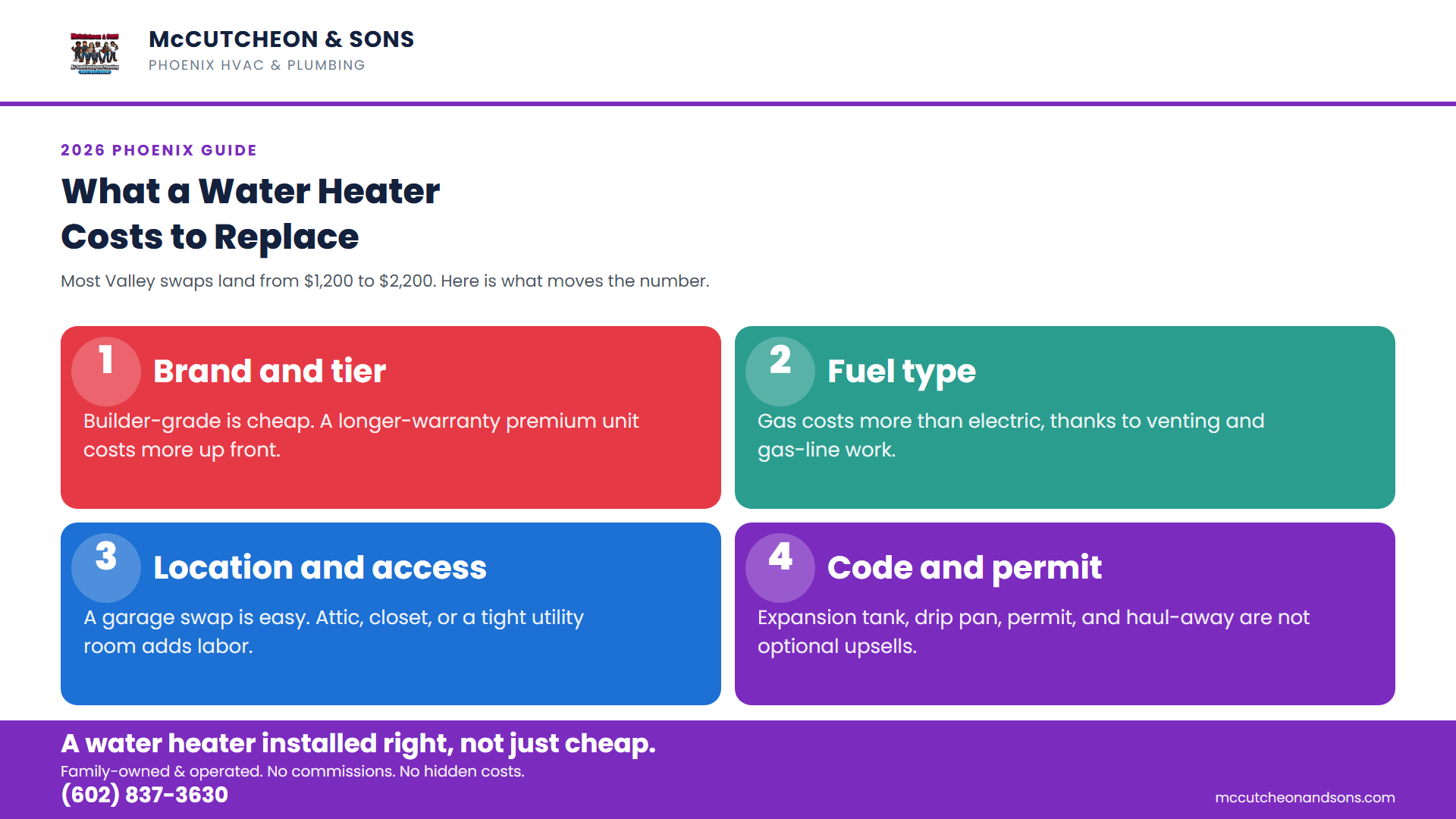
Water heater replacement cost in Phoenix: the four factors that move the price from $1,200 to $2,200

The honest price range in Phoenix

For a standard tank water heater, installed, here is where real jobs land in the Phoenix metro:

  • 40-gallon electric tank: roughly $900 to $1,500 installed.
  • 40-gallon gas tank: roughly $1,100 to $1,800 installed.
  • 50-gallon gas tank: roughly $1,200 to $2,200 installed.

Those numbers assume a straightforward swap in the same spot with no major surprises. A 50-gallon gas tank is the most common replacement in the valley, and the $2,650 quote you are holding is at the high end of reasonable if it includes a quality unit, an expansion tank, a new pan, and a permit, but high if it is just the tank and an hour of labor.

Tankless and heat pump units cost more, and they should. A gas tankless replacement in Phoenix typically runs $2,500 to $5,500 installed, because the unit costs more and the install often needs a larger gas line or a different vent. A heat pump water heater runs $2,500 to $4,500 installed. If someone quoted you a tankless for $1,500, check what they are leaving out, because something is missing.

What actually drives the price

The heater itself is only part of the bill. The rest comes from six things, and they are the difference between a $1,200 job and a $2,600 job for the same-size tank.

Brand and tier. A builder-grade Rheem or AO Smith costs less than a Bradford White or a higher-end unit with a longer warranty. You are partly paying for the tank’s expected life and how easy parts are to get later.

Fuel type. Gas heaters usually cost a little more than electric because of the venting and gas-line work, even though the tank itself is similar. Switching from gas to electric or the other way around is a much bigger job and should be quoted as such.

Location and access. A heater in an open garage is an easy job. A heater in an attic, a closet, or a tight utility room takes longer, and that time is real money.

Code upgrades. Phoenix and the surrounding cities require an expansion tank on many closed systems, a proper drip pan with a drain, and a permit. Older houses often do not have the expansion tank, so it gets added during the swap. These are not optional upsells. They are code, and they are part of why a “just the tank” quote looks suspiciously cheap.

Disposal and haul-away. The old 50-gallon tank weighs a lot and has to leave your property. Make sure the quote says who takes it.

The permit. A permitted job means an inspection, and an inspection means the work has to be right. Companies that skip permits can quote lower. That is not a deal, that is a risk you are inheriting.

The line items you should see on a real quote

A fair water heater replacement quote itemizes more than a single number. At minimum, look for:

  • The heater, with brand, model, capacity, and warranty length.
  • The expansion tank, if your system needs one.
  • The drip pan and drain line.
  • The gas line or electrical connection work, if any.
  • Vent or flue changes, for gas.
  • Permit and inspection.
  • Disposal of the old unit.
  • Labor, listed separately.

If the quote you are holding is one line that says “water heater, installed,” ask for the breakdown. A company that will not itemize is either hiding margin or hiding a shortcut, and neither one is your friend. The Department of Energy has a plain-language guide to selecting a new water heater if you want to compare types before you talk to anyone.

The $2,650 question, answered

So is $2,650 fair? For a premium 50-gallon gas tank with an expansion tank, a new pan, a permit, and haul-away, it is at the top of normal but defensible, especially in a tighter install. For a basic 40-gallon electric tank with nothing else included, it is high by a wide margin.

The honest way to judge it is to pull apart the quote and see what is inside. Two jobs can be priced $1,000 apart and both be fair, because they are not actually the same job. The number you should question is not the total. It is whether the total is explained.

The hidden costs that surprise people

Beyond the tank, here is where homeowners get caught off guard:

  • Gas line upsizing. A tankless unit or a larger tank may need a bigger gas line run from the meter. That can add real cost and it is often left off the first quote.
  • Electrical work. An electric tankless unit can need a dedicated circuit or a panel upgrade, sometimes $1,000 or more before you have even bought the heater.
  • Seismic straps and stands. Code in this part of the country requires the tank to be strapped and, in a garage, often raised on a stand. An installer who “forgets” these is cutting corners, and you will pay for it later.
  • Water shut-off or leaks found mid-job. A 15-year-old shut-off valve that crumbles when touched is common. A good installer tells you before they touch it, not after.

How not to overpay

Get at least two itemized quotes and compare line items, not totals. Ask directly whether the price includes the permit, the expansion tank, and disposal. Ask what brand and model they are installing, and why. A company that can answer all three without hesitation is quoting you honestly, whether their number is a little higher or a little lower than the next one.

We have been replacing water heaters across Phoenix and the east valley since 1999, and every quote we write is itemized for exactly this reason. You should know what you are paying for, down to the last line. If you have a number in hand, bring it to us. We will tell you if it is fair, even if that means telling you the other guy is a better deal.

Have a quote you want a straight answer on? We’re one call away.

McCutcheon & Sons is a family-owned and operated HVAC and plumbing company serving Phoenix and the east valley: Gilbert, Chandler, Mesa, Queen Creek, San Tan, Tempe, Maricopa, Scottsdale, and Fountain Hills. Since 1999, one name on the truck, the quote, and the door. Licensed #339149. No commissions, no hidden costs, guaranteed work.

Call (602) 837-3630

McCutcheon & Sons Air Conditioning and Plumbing · (602) 837-3630 · mccutcheonandsons.com · AZ ROC License #339149

Posted on

Tank vs. Tankless Water Heater: Which Makes Sense in Phoenix Heat


McCUTCHEON & SONS
PHOENIX HVAC & PLUMBING
SINCE 1999 · FAMILY-OWNED · LICENSED #339149
Tank vs. Tankless Water Heater
Which makes sense in Phoenix heat
mccutcheonandsons.com
(602) 837-3630

Your water heater dies on a Tuesday, which is how they always go. You open the garage door, see the puddle, and start googling. Within an hour the same question is in front of you: do I replace it with another tank, or do I switch to tankless?

Everyone online has an opinion, and most of them are written for a house in Ohio, not a garage in Chandler that hits 120 degrees in August. The right answer for Phoenix is not the same as the right answer for Cleveland, and it comes down to three things: our water, our heat, and how many people are trying to shower at the same time.

Tank vs. tankless water heater in Phoenix: endless hot water versus the cheapest install

The real difference, in one paragraph

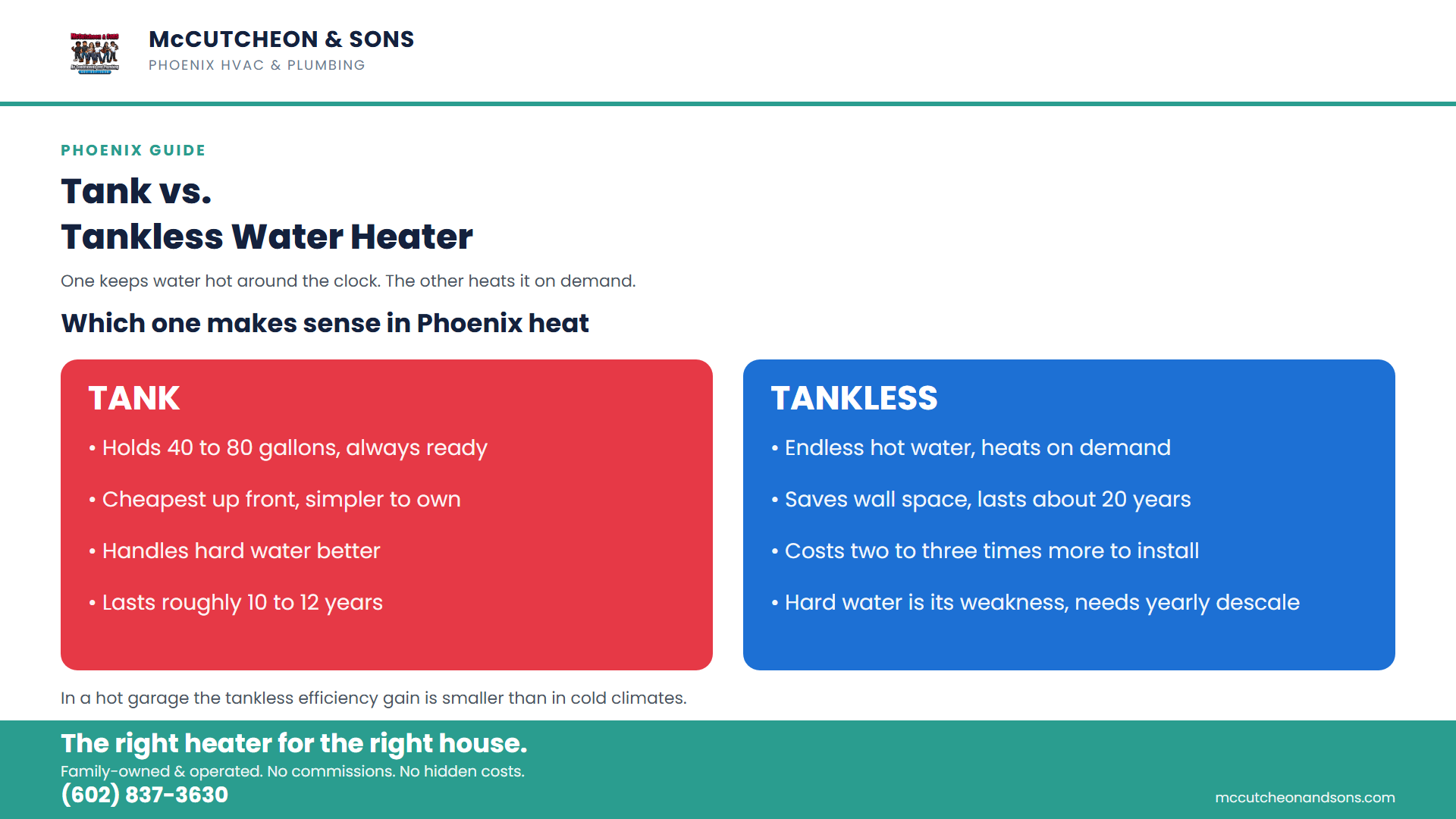
A tank water heater stores 40 to 80 gallons of hot water and keeps it hot around the clock, so it is always ready. A tankless water heater has no tank at all. It heats water on demand as it flows through a heat exchanger, which means you never run out of hot water, and you never pay to keep a tank warm while you sleep.

That trade-off is the whole debate. Tankless is more efficient and takes up less wall space. A tank is cheaper up front and simpler to own. Everything after that is about where you live. You can read the Department of Energy’s breakdown of tankless water heaters for the national view, but here is the Phoenix view.

Why Phoenix heat changes the math

Here is a Phoenix-specific fact nobody in the national articles mentions: our inlet water temperature is warm. Water coming into the house can be 75 to 85 degrees in the summer, which is far warmer than the 40-degree inlet water a tankless unit in the Midwest has to fight. A tankless heater only has to raise the temperature a small amount here, which is exactly the situation where tankless shines. Less energy in, less strain on the unit.

The flip side is our hard water. Phoenix water is mineral-heavy, and those minerals are what ruin tankless units faster than anything else. A heat exchanger with hard-water scale on it runs less efficiently, triggers error codes, and eventually fails. Tankless units in Phoenix need a descaling flush about once a year, and skipping it is the number one reason we see them die young. A tank is more forgiving of hard water because the minerals settle to the bottom, where a flush or a new anode rod deals with most of it.

Upfront cost vs. long-term savings

Be ready for the sticker price. A tankless water heater runs roughly two to three times the installed cost of a standard tank, and the install is not always a simple swap. A gas tankless unit often needs a larger gas line and a different vent, and an electric tankless unit can need a serious electrical upgrade, sometimes a dedicated circuit or a service panel bump. Those costs are real, and a good plumbing quote will lay them out for you before you commit.

The savings on the other side are real too but modest. You stop paying to keep 50 gallons hot all day, and tankless units last longer when they are maintained, often 20 years to a tank’s 10 to 12. In Phoenix’s heat, where a water heater in an unconditioned garage barely has to work to stay warm, the efficiency gain from tankless is smaller than it is in a cold climate. Do not expect the energy savings alone to pay for the upgrade quickly. People pick tankless here for endless hot water and wall space, not because the utility bill makes them rich.

The hard-water problem, head on

If you go tankless in Phoenix, commit to the maintenance or do not buy one. A tankless unit on hard water should be descaled yearly, and in some parts of the valley, every six months. It is a simple flush with a pump and a mild acid, and we do it as part of a service visit, but it is not optional. Skip it for a couple of years and the unit will throw an error code in the middle of someone’s shower, which is the exact moment most people regret the decision.

A traditional tank needs less attention. Flush the sediment once a year, replace the anode rod when it is spent, and it will do its job. If you know you are not going to remember a yearly maintenance appointment, a tank is the honest choice.

The option most people miss: the heat pump water heater

Between tank and tankless there is a third choice that fits Phoenix better than almost anywhere else: a heat pump water heater, sometimes called a hybrid. It pulls heat from the air around it to warm the water, instead of burning gas or running heating elements directly.

In a Phoenix garage, where the air is already 100 degrees for half the year, a heat pump water heater is wildly efficient. It also gives off cool, dry air as a side effect, which turns your garage water heater into a small air conditioner. The catch is that it needs air around it and a bit more space, and it costs more up front than a tank. But if your water heater lives in an open garage, it is often the best balance of efficiency, cost, and low drama. It is the option national blogs leave out, and it is the one we recommend most often in the east valley.

Which one should you pick

Here is the short version. Go with a tankless unit if you have a big household that keeps running out of hot water, you value the wall space, and you are willing to keep up with yearly descaling. Go with a standard tank if you want the lowest up-front cost and the least maintenance, and your current tank was keeping up fine. Go with a heat pump water heater if your unit lives in an open garage and you want real efficiency without the tankless maintenance.

Every house is different, and the right call comes down to your gas and electric setup, your water hardness, and how many people live under your roof. If you are not sure, that is exactly what a quick look from someone who works in these garages every day is for. We have been replacing water heaters across Phoenix, Gilbert, Chandler, Mesa, and Queen Creek since 1999, and we would rather talk you out of the wrong unit than sell you the pretty one.

Not sure which water heater fits your house? We’re one call away.

McCutcheon & Sons is a family-owned and operated HVAC and plumbing company serving Phoenix and the east valley: Gilbert, Chandler, Mesa, Queen Creek, San Tan, Tempe, Maricopa, Scottsdale, and Fountain Hills. Since 1999, one name on the truck, the quote, and the door. Licensed #339149. No commissions, no hidden costs, guaranteed work.

Call (602) 837-3630

McCutcheon & Sons Air Conditioning and Plumbing · (602) 837-3630 · mccutcheonandsons.com · AZ ROC License #339149