
Posted on

How to Tell If Your HVAC Quote Is Fair (Get a Second Opinion Before You Sign)


McCUTCHEON & SONS
PHOENIX HVAC & PLUMBING
SINCE 1999 · FAMILY-OWNED · LICENSED #339149
How to Tell If Your HVAC Quote Is Fair
Get a second opinion before you sign
mccutcheonandsons.com
(602) 837-3630

Your AC gives out on a 114-degree day in July. You call a company, a tech walks through your house, and an hour later you are staring at a $14,000 number with a line for your signature already drawn. You do not know enough about HVAC to argue with it, and you are hot, so you almost sign.

Almost. Here is the thing most Phoenix homeowners find out too late: two honest companies can quote the same exact job and land thousands of dollars apart. The gap is not always a scam. Sometimes it is a signal that one of them saw something the other missed.

You do not need to become an HVAC expert to tell the difference. You need to know what a fair quote includes, what the red flags look like, and how to get a real second opinion without wasting a week.

Is your HVAC quote fair? Five red flags to spot before you sign

Why two honest quotes can land thousands apart

First, set expectations. A wide price gap is normal up to a point. The same 4-ton AC replacement in Phoenix can legitimately range from about $8,000 to $15,000 depending on five things: the brand and tier of equipment, the efficiency rating, the scope of the work, the quality of the labor, and the time of year.

Equipment is the obvious one. A builder-grade unit costs less than a name-brand variable-speed system, and both will cool your house. Efficiency matters too. A 14 SEER2 unit and a 20 SEER2 unit can differ by a few thousand dollars on the same brand. Higher efficiency saves you money on APS or SRP bills, but it does not change how cold the air is today.

Scope is where quotes drift apart. Does the price include new ductwork, a new pad, a disconnect, a permit, and disposal of the old unit, or just the box? Does it include the crane or the second crew member that a tight attic job needs? Two companies quoting the same equipment can be $2,000 apart simply because one included the permit and the other left it off the paper to look cheaper.

The point: a gap under about 15 percent is usually explained by these factors. A gap over that deserves an explanation. If the company cannot give you one in plain English, that is your first red flag, and it has nothing to do with how much you know about refrigerant.

What a fair quote actually includes

You should never be asked to sign a number that is not itemized. A fair HVAC quote, whether it is a repair or a full replacement, breaks out at least these lines:

  • The exact equipment, by brand and model number, not just “a 4-ton unit.”
  • The capacity and efficiency rating, so you can confirm it matches what your house needs.
  • Labor, listed separately from parts.
  • Permits and whether the company pulls them or expects you to.
  • Disposal and haul-away of the old equipment.
  • Warranty terms, both the manufacturer’s and the labor warranty on top.
  • A timeline: when they start and when they finish.

If a quote is one bottom-line number with nothing behind it, that is not a company being simple with you. That is a company leaving itself room to change the story later. A fair quote answers your questions before you ask them.

Red flags that mean a quote is too high

Some pricing is aggressive because the company is built that way. A high-pressure, high-overhead operation has to charge more to cover the trucks, the call center, and the ad budget. That does not make them dishonest, but it does mean you are paying for marketing, not necessarily for better work.

Here is what separates “expensive” from “taking advantage of you.” A quote that is too high almost always comes with one of these attached:

  • A “today only” discount. If the price drops because you act before the tech leaves, the first number was never real. Honest pricing does not expire when the van pulls away.
  • An upsell wrapped in a membership. The “maintenance plan” that magically makes the big repair cheaper is often just the company financing its own discount while locking you into future visits. See maintenance plans for what a plan should actually cover.
  • A bigger unit than you need. If a company quotes a 5-ton system without measuring your house or checking the ductwork, they are not solving your problem, they are selling you the most expensive version of it.
  • No measurement at all. A proper load calculation (called a Manual J) tells them the right size. If the tech sized your system from the old unit’s data plate and a glance at the square footage, the quote is a guess, and guesses trend expensive.

None of these are subtle. Once you know to look for them, they are hard to miss, which is the whole point of getting a second opinion in the first place.

The too-low quote is a trap too

It is tempting to assume the cheapest bid is the safe one. In Phoenix it is usually the opposite. A quote that undercuts everyone else by 30 percent is not a bargain, it is a business model.

Low bids get made back in predictable places: unbranded or gray-market equipment, no permit, a crew paid by the job and rushing through it, and a warranty that exists on paper but not in practice. Sometimes the low number is bait, and the real work “surprises” you mid-job after the old unit is already out of the attic.

The cheapest company in town is rarely the cheapest by accident. If the gap between your highest and lowest bid is huge, the low one is hiding something, and what it is hiding is usually you.

How to get a real second opinion in Phoenix

Getting a second opinion does not mean scheduling three more four-hour appointments. It means being deliberate about the one or two extra quotes you do collect.

Start by comparing line items, not bottom lines. Take the itemized quote you have and ask the next company to bid the same scope. If they come back cheaper, find out which line moved. That single question tells you more than reading every review on the internet.

Ask whether they will pull a permit and whether the price includes it. Ask how they sized the system, and listen for the words “load calculation” instead of “this is what you had before.” Confirm the license and check reviews from people in the east valley, not just a five-star average. A company that has been serving Phoenix, Chandler, Mesa, and Gilbert for years with a real local reputation has something to protect, and it shows in how they quote.

And remember what a second opinion is for. You are not shopping for the lowest number. You are shopping for the number that is explained. When a company can tell you exactly why the price is what it is, in a way you understand, that is the one to trust, whether it is a little high or a little low.

What McCutcheon puts in every quote

We have been a family-owned shop in Phoenix since 1999, and we quote the way we would want our own parents quoted. Every estimate from us is itemized, with the exact equipment, the efficiency rating, labor, permit, and disposal broken out line by line. There are no commissions on our trucks, so nobody is paid to upsell you, and there is no hidden cost that appears after you sign. If our number comes in higher than a competitor’s, we will tell you why in plain English, and if theirs is higher, we will tell you that too.

That is what a fair quote looks like. If you have a number in hand that you are not sure about, bring it to us before you sign. We will look at it honestly, even if that means telling you it is a good deal. That second look is free, and it might be the cheapest peace of mind you buy all summer. One more free check: any Arizona contractor’s license is public record. Verify it through the state’s Registrar of Contractors before you sign anything.

If a straight answer on your quote sounds right, we’re one call away.

McCutcheon & Sons is a family-owned and operated HVAC and plumbing company serving Phoenix and the east valley: Gilbert, Chandler, Mesa, Queen Creek, San Tan, Tempe, Maricopa, Scottsdale, and Fountain Hills. Since 1999, one name on the truck, the quote, and the door. Licensed #339149. No commissions, no hidden costs, guaranteed work.

Call (602) 837-3630

McCutcheon & Sons Air Conditioning and Plumbing · (602) 837-3630 · mccutcheonandsons.com · AZ ROC License #339149
Posted on

Emergency & 24-Hour AC Repair in Phoenix: What to Expect (and What It Costs)


McCUTCHEON & SONS
PHOENIX HVAC & PLUMBING
SINCE 1999 · FAMILY-OWNED · LICENSED #339149
Emergency & 24-Hour AC Repair in Phoenix
What to Expect (and What It Costs)
mccutcheonandsons.com
(602) 837-3630

It’s 10 p.m. on a July night, it’s still 106 outside, and the air conditioner just went quiet. You search “emergency ac repair phoenix” on your phone and start working down the list. What happens over the next hour comes down to one thing: who actually answers.

Some of those numbers put you on the line with a dispatcher who can have a tech at your door before midnight. Others send you to an answering service that logs the call and schedules a callback for the morning. The difference is the difference between sleeping in your own bed tonight and finding a hotel room.

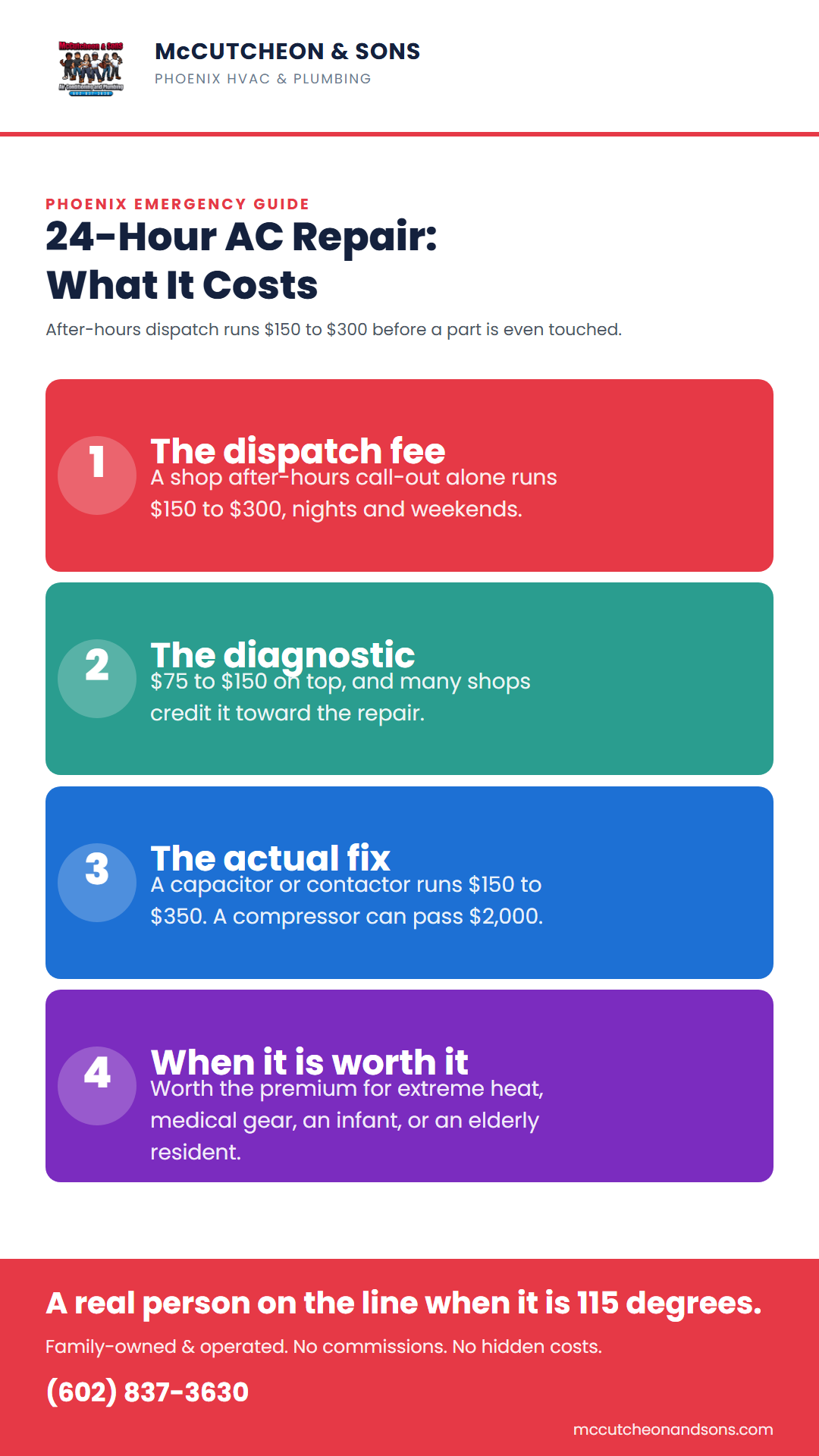
Emergency and 24-hour AC repair cost in Phoenix: dispatch fee, diagnostic, and the fix

What “24-hour” actually means in Phoenix

Plenty of shops in the Valley advertise 24-hour AC repair without actually keeping a tech awake and on call. What a lot of them do instead is forward the after-hours line to a service that takes your name, your number, and a note that says “customer called about AC.” Someone reads that note the next morning.

The operations that are genuinely 24-hour answer with a person and can put a tech on the road the same night. That’s the whole test. When you call, ask it straight: is there a tech on call right now, or am I leaving a message? The answer tells you more than the website ever will.

What an emergency call costs

Emergency AC repair in Phoenix costs more than the same repair at 2 p.m. on a Tuesday. Most shops charge an after-hours dispatch fee on top of the diagnostic, and that fee is what covers getting a tech out of bed and across the Valley at 11 p.m.

The bill usually breaks into three parts: the after-hours dispatch fee, the diagnostic fee, and the actual repair. Here’s the one worth knowing: at a lot of shops the diagnostic fee rolls into the repair if you move forward, so you’re not paying it twice. Ask before they send anyone.

Ballpark, in the Valley: an after-hours dispatch fee usually lands between $150 and $300, a diagnostic between $75 and $150, and a common fix like a capacitor or contactor between $150 and $350 in parts and labor. Add it up and a straightforward emergency repair often runs $300 to $800 all in. A failed compressor is a different animal, and it can push a single emergency visit past $2,000. Those are ranges, not quotes. Your system, your failure, your number. But they give you a floor to compare against when a shop tosses out a figure at midnight.

Same-day repair isn’t the same as emergency repair

Search “same day ac repair arizona” and “emergency ac repair phoenix” and Google hands you mostly the same list of shops. The two services bill differently, though.

Same-day means a tech gets there before the day is out, at standard daytime rates. It’s the right call when your AC dies at 9 a.m. on a weekday. Emergency means nights, weekends, and holidays, and it carries the after-hours premium. If you can hold out until business hours, you’ll usually pay less for the same fix.

The catch is Phoenix summers. When it’s 112 and every shop’s schedule is full, “same-day” can quietly turn into “two days out.” That’s when the after-hours premium starts looking cheap against the cost of a hotel or a night without sleep.

Ask these before they send a tech

Four questions, asked before you hang up, save you a bad night and a wasted trip fee.

  1. Do you have a tech who covers my area? Queen Creek, San Tan, and Maricopa are far enough out that some shops charge a trip fee or won’t come at all. Lead with this.
  2. Does the diagnostic fee count toward the repair? If the answer is no, that’s fine. You just want the real number going in.
  3. What parts do you carry on the truck? Capacitors, contactors, and fan motors cover the most common failures. A shop that stocks them can fix you tonight; one that doesn’t will order parts and come back in two days.
  4. What’s your AZ ROC license number? Every legitimate contractor has one, and it’s public record. Verify it through the state’s Registrar of Contractors before you sign.

You don’t need to grill anyone. These four take ninety seconds, and a good shop answers all of them without blinking.

Why summer peak changes everything

In July and August, the big franchises book out days in advance. The heat spike swallows their schedule, and “we can be there Thursday” is a real answer when the AC is dead on a Monday.

Local shops that run their own dispatch are different. They tend to keep a slot or two open for a genuine emergency, which is how a same-day fix becomes realistic in the middle of a heat wave. If it is a genuine emergency, say so: a household with medical equipment, an infant, or an elderly parent moves to the front of the line at any shop that takes its work seriously.

That’s also where reputation shows up. When you’re picking blind, look for reviews that name an actual tech and describe an actual repair, not just “great service.” Those are the shops that answer the phone with a person.

While you wait, do these three things

You don’t have to sit and wait for the tech. Three small things now make the visit faster and cheaper.

  1. Grab the model and serial number off the unit and write down the symptom in one line. “Outdoor unit not running” is a completely different problem than “blowing warm air,” and that one sentence routes the tech to the right fix before they even park.
  2. Check the basics. A tripped breaker or a clogged filter is behind a surprising number of emergency calls, and both are free to fix.
  3. If the unit is short-cycling, banging, or sounding wrong, switch it off at the thermostat. A struggling system does more damage the longer it limps along, and you don’t want a small repair turning into a big one.

When it’s time to replace instead of repair

Here’s the number that saves people from throwing money at a dying unit: in Phoenix, an AC system lives about 12 to 15 years. If yours is in that range and the tech’s quote is for a compressor or a coil, you’re usually better off putting that money toward a new system.

That doesn’t mean rush into a replacement at midnight. It means get a straight number for both options, repair and replace, and decide in the morning when you’re not standing in a hot house. A good shop gives you a straight number without a sales pitch.

If your AC is out tonight and you’d rather talk to a person than leave a message, we’re one call away.

McCutcheon & Sons is a family-owned and operated HVAC and plumbing company serving Phoenix and the east valley: Gilbert, Chandler, Mesa, Queen Creek, San Tan, Tempe, Maricopa, Scottsdale, and Fountain Hills. Since 1999, one name on the truck, the quote, and the door. Licensed #339149. Real techs on call, no commissions, no hidden costs, guaranteed work.

Call (602) 837-3630

McCutcheon & Sons Air Conditioning and Plumbing · (602) 837-3630 · mccutcheonandsons.com · AZ ROC License #339149
Posted on

AC Not Cooling Enough? What to Check Before You Call a Tech


McCUTCHEON & SONS
PHOENIX HVAC & PLUMBING
SINCE 1999 · FAMILY-OWNED · LICENSED #339149
AC Not Cooling Enough?
What to Check Before You Call a Tech
mccutcheonandsons.com
(602) 837-3630

It’s the middle of a Phoenix summer and the thermostat reads 80 while you set it to 74. The unit is running. The air is moving. It just isn’t cold. Before you search “ac not cooling phoenix” and call someone out, there are a handful of things worth checking yourself. Some of them cost nothing. A few take ten minutes. And knowing them saves you from paying a diagnostic fee for a fix you could’ve done for free.

Phoenix heat is hard on air conditioning. When a unit struggles here, the problem is usually one of a short list. Here’s how to work through it in order, from the cheapest fix to the one that actually needs a tech.

AC not cooling in Phoenix: five cheap checks to try before you call

Rule out the free stuff first

Three things cause more “my AC isn’t cooling” calls in Phoenix than anything else, and none of them need a service call.

First, the air filter. Phoenix dust clogs a filter fast, and a clogged filter chokes airflow until the coil ices over. An iced coil stops absorbing heat, and suddenly the air coming out is warm. This is the single most common cause of AC blowing warm air, and the fix is a ten-dollar filter.

Second, the thermostat. If yours sits in direct afternoon sun or against a hot west wall, it reads a few degrees high and short-cycles the system, so the house never actually reaches the number you set.

Third, the breaker. If the inside blower is running but the outdoor condenser is silent, check the panel. A tripped breaker or a blown capacitor is a cheap, common fix. A silent outdoor unit is not always a dead system.

The three fixes that cost almost nothing

Start with the filter. Pull it and hold it up to the light. If you can’t see light through it, replace it. While you’re out there, check the outdoor condenser: it needs clearance to breathe. Monsoon debris, weeds, and dust built up against the coil make the unit work harder and cool less. Hose it off gently with the power off.

Then check the drain line. A clogged condensate line trips the float switch on a lot of newer systems and shuts the whole thing down, which reads exactly like a dead AC.

These are the fixes a good tech checks before quoting you a single part. Doing them yourself just means you’ve already handled the first fifteen minutes of the diagnostic.

Know when it’s really low refrigerant

“Low refrigerant” is the most misdiagnosed call in Phoenix. A system that leaks doesn’t use up refrigerant the way a car uses gas. Refrigerant lives in a sealed loop. If it’s genuinely low, there’s a leak, and that leak has to be found and fixed, not just topped off.

What techs actually find a lot of the time is a dirty coil or a restricted duct that makes the system act low on charge. The symptoms are identical: warm air, longer run times, higher bills. That’s why you want a diagnostic that checks the coil and airflow, not just the pressure gauge. A ten-minute coil inspection catches what a pressure reading alone will miss.

Know the difference between a real problem and Phoenix heat

Here’s a number that saves a lot of people a service call: a properly working AC can only drop the indoor temperature about 15 to 20 degrees below the outdoor temperature. If it’s 115 outside and your house is holding at 78 or 80, the unit may be working exactly as designed. That’s the physical limit, not a failure.

If it’s warmer than that indoors, the usual culprits in the Valley are a dirty or undersized coil, a refrigerant charge that has drifted low over the years, or the one most people miss: leaky attic ducts dumping your cold air into a 140-degree attic. Duct leaks are the reason two identical units cool two identical houses completely differently.

When to stop guessing and call

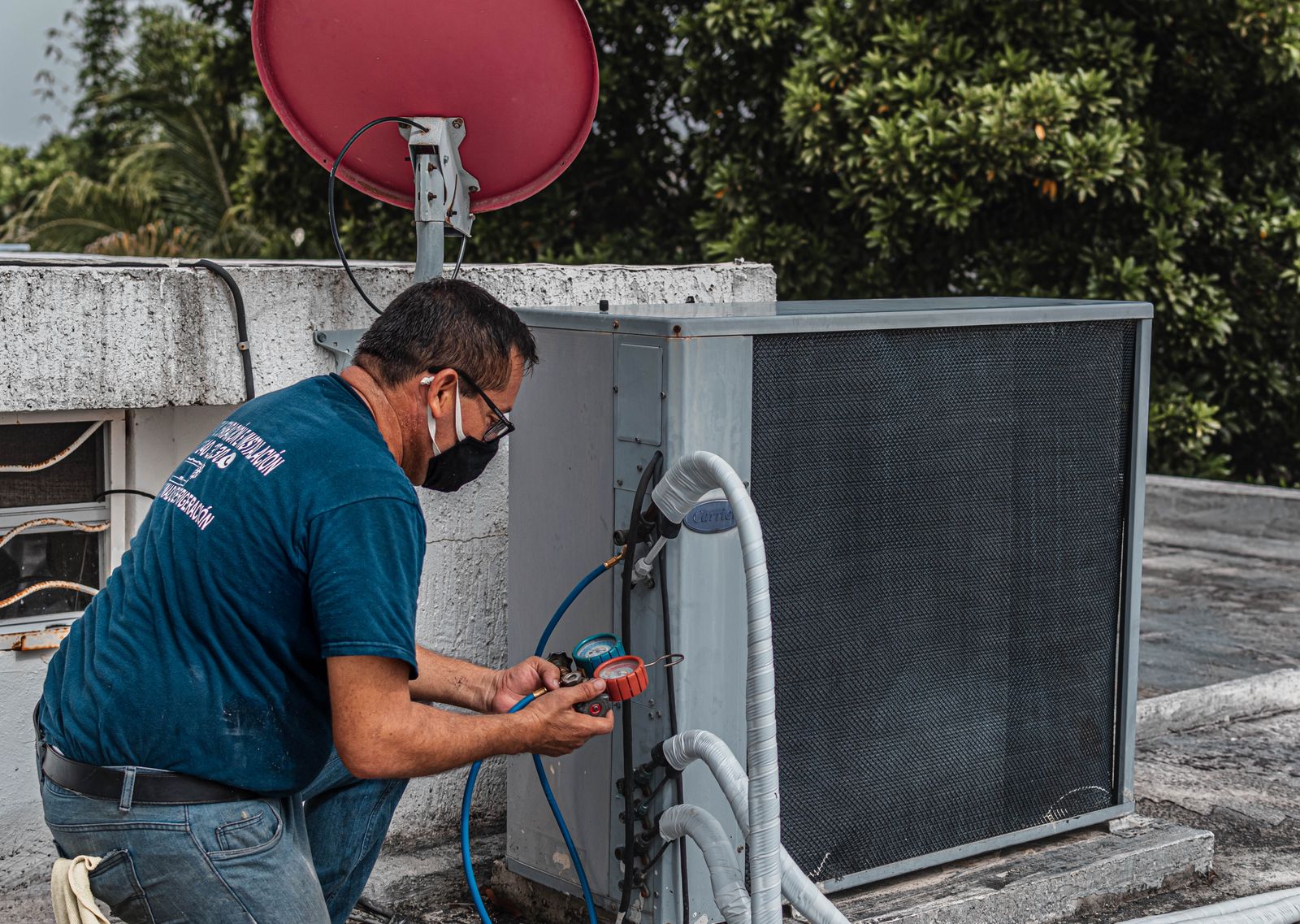
Work the list in order. If the filter is clean, the thermostat is fine, the outdoor unit is running, and the air is still lukewarm, that’s when it’s worth a real diagnostic. Anything beyond a simple filter or breaker fix, especially a refrigerant or coil issue, is not a DIY job. The tools to do it right aren’t in a homeowner’s garage, and guessing with a recharge you don’t need makes the real problem worse and more expensive later.

The right tech shows up, checks the coil and airflow, tells you whether it’s a cheap fix or a real repair, and gives you a straight number before they touch anything.

If your AC isn’t keeping up and you’d rather have a straight answer than a sales pitch, we’re one call away.

McCutcheon & Sons is a family-owned and operated HVAC and plumbing company serving Phoenix and the east valley: Gilbert, Chandler, Mesa, Queen Creek, San Tan, Tempe, Maricopa, Scottsdale, and Fountain Hills. Since 1999, one name on the truck, the quote, and the door. Licensed #339149. No commissions, no hidden costs, guaranteed work.

Call (602) 837-3630

McCutcheon & Sons Air Conditioning and Plumbing · (602) 837-3630 · mccutcheonandsons.com · AZ ROC License #339149

Posted on

Family-Owned vs. Franchise HVAC Companies: What’s the Difference in Phoenix

HVAC Tools


McCUTCHEON & SONS
PHOENIX HVAC & PLUMBING
SINCE 1999 · FAMILY-OWNED · LICENSED #339149
Family-Owned vs. Franchise HVAC Companies
What’s the Difference in Phoenix?
mccutcheonandsons.com
(602) 837-3630

Every year, more of the trucks rolling through the Valley carry names that used to belong to a family. The name didn’t change. The ownership did.

It’s one of the bigger changes in Phoenix HVAC and plumbing right now, and most people don’t see it until they’re standing in a hot house at 4 p.m. in July, searching “family owned HVAC company Phoenix” and hoping the person who shows up actually cares whether the AC works tonight.

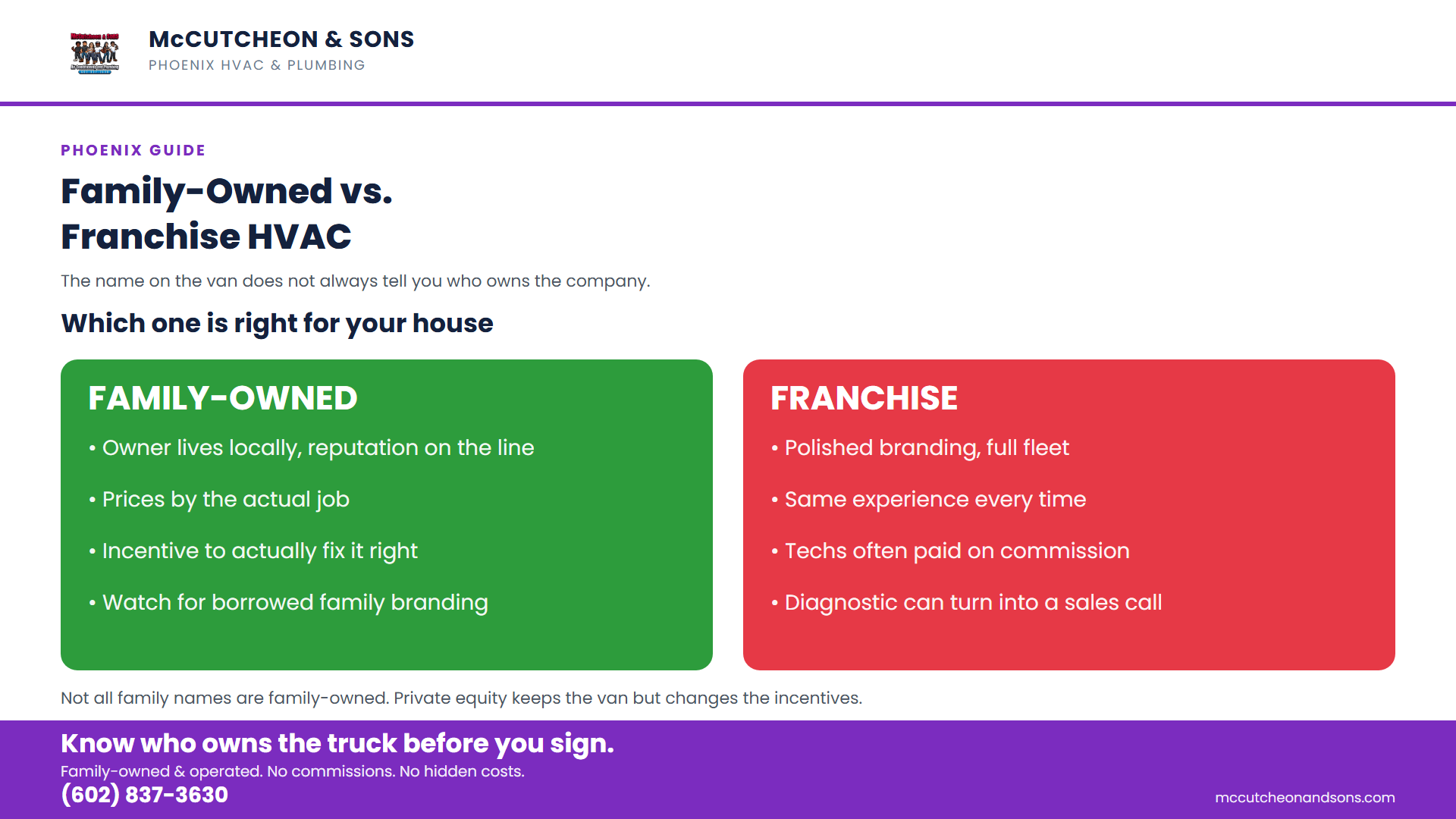
The phrase “family owned” is one of the most borrowed in the trades. Some companies that use it are genuinely family run. Others are franchises or private-equity roll-ups that kept the old name on the door and the family photo on the website. The difference shows up in your quote, in the tech who arrives, and in what you pay.

Family-owned vs. franchise HVAC in Phoenix: who actually owns the truck

The name on the truck isn’t always who owns it

Phoenix has become a favorite target for what Wall Street calls roll-ups. A private-equity firm buys a successful local HVAC or plumbing company, keeps the name, keeps the vans, keeps a photo of the founder on the homepage, then changes how the business runs.

The incentives flip. A family owner who’s lived in Chandler for twenty years is thinking about one thing: doing right by the neighbor who called, because that neighbor is at the same school pickup tomorrow. A portfolio company answers to a board that wants the numbers up this quarter.

Neither fact is a secret. It’s just not printed on the side of the van.

What a franchise actually is

A franchise isn’t the same as a big brand, and it isn’t the same as a family shop. It’s a legal structure: someone pays to use a name, a playbook, and a marketing machine in exchange for a cut of the revenue. You’ve seen the trucks: big-name outfits, polished branding, a full fleet. That structure creates specific incentives.

Franchise techs are often paid on commission or expected to hit revenue targets, so the diagnostic can turn into a sales call. Pricing is standardized across the whole region, which leaves little room for a tech to tell you the $450 line item is actually a $90 fix. You get the same experience every time, which is great when it’s good and expensive when it’s not the right call for your house.

Ask yourself what you’re actually buying: the name on the truck, or the person holding the wrench?

Private equity is harder to spot

Private-equity ownership is the one people miss, because there’s no franchise fee and no name change. The company looks exactly like it always did. The difference lives on a spreadsheet you’ll never see.

When a PE firm buys a plumbing or HVAC company, it usually borrows to do it. That debt has to be repaid, and the repayment comes from one place: the customer. So the company starts pushing bigger-ticket work (a replacement instead of a repair), higher-margin equipment, and membership plans sold hard at the door. Fewer callbacks sounds good until it starts meaning fewer trips to actually finish the job.

None of this makes a PE-backed company automatically bad. It makes the incentives different from yours.

How to tell the difference before you sign

You don’t need a background check. You need four questions, and then you watch what happens next.

How to tell if your HVAC company is truly family-owned: 4 questions

Four questions that expose the difference between a family shop, a franchise, and private equity.

  1. Who owns the company? A family shop answers in one sentence, with a name. A firm, a group, or a “partner” is your signal.
  2. Are the techs paid commission? A company that’s proud to answer “no” will say so right away.
  3. Is it the same name on the quote, the truck, and the insurance? A roll-up sometimes runs several names under one roof.
  4. Repair or replace, what’s the honest call? A straight answer with real numbers is the whole test.

One more free check: any Arizona contractor’s license is public record. Verify it through the state’s Registrar of Contractors before you sign.

Why Phoenix makes this matter more

Phoenix breaks HVAC systems. Our AC units run three times as many hours as a unit in, say, Chicago. They die younger and cost a lot to replace. That makes the Valley a prime hunting ground for high-pressure sales and markups. It also makes the gap between a family shop and a franchise or PE operation worth real money.

A full system replacement is a big number either way. A company paying off acquisition debt and commission targets prices that job differently than a shop that just wants you comfortable by Friday and still a customer in ten years.

The honest take

None of this means every franchise is bad or every family shop is honest. There are good franchise operations and sloppy family businesses. Stop assuming the name tells you anything.

The difference that actually matters is the incentives. A family-owned company in Phoenix lives or dies on its reputation in one market. That’s a specific kind of accountability. It’s the reason people go looking for it in the first place.

When your AC is out in August, you don’t need the biggest brand. You need someone who shows up, tells you the truth about what’s broken, and charges what it actually costs to fix it.

If that sounds like the company you’ve been searching for, we’re one call away.

McCutcheon & Sons is a family-owned and operated HVAC and plumbing company serving Phoenix and the east valley: Gilbert, Chandler, Mesa, Queen Creek, San Tan, Tempe, Maricopa, Scottsdale, and Fountain Hills. Since 1999, one name on the truck, the quote, and the door. Licensed #339149. No commissions, no hidden costs, guaranteed work.

Call (602) 837-3630

McCutcheon & Sons Air Conditioning and Plumbing · (602) 837-3630 · mccutcheonandsons.com · AZ ROC License #339149